If you are running workplace training, communication activities can be a simple way to get people involved. The 12 exercises below cover areas such as active listening, feedback, body language, and working with others.
They can also help employees practice everyday situations such as giving feedback, resolving conflict, delegating tasks, and working with colleagues.

For more guides on listening, feedback, body language, and workplace conversations, you can also take a look at our workplace communication guides for managers, HR professionals, and trainers.
1. Two Truths and a Lie (With a Communication Twist)
Time Needed: 10 – 15 minutes
Group Size: 4 – 10 participants
Objective: To practice clarity, persuasion, and interpreting tone/body language.
Instructions
Each participant must provide three statements about themselves, and two of these statements should be true, and one must be a lie. The task for the group will be to guess which is the lie.
To make it communication-focused, ask participants to use tone or emphasis to try to disguise their lie, encouraging subtle persuasion and non-verbal tactics.
Trainer Tip
Use this at the start of a session to build rapport while observing how verbal and non-verbal cues can reveal meaning.
See the full instructions and variations.
2. Clarifying Questions Icebreaker
Time Needed: 10–15 minutes
Group Size: 4–10 participants
Objective: To help participants recognize how easily we make assumptions and to practice asking clear, thoughtful questions to improve understanding.
Instructions
1. Pair up the participants.
Then explain that during the activity, they will have the chance to try out both roles: the explainer and the questioner.
To start with, though, one person will be the explainer and the other the questioner, and then afterward they will rotate roles.
2. Choose a topic to explain.
The explainer describes how to carry out a process or task, such as:
- How to make a cup of tea in complete darkness
- How to find your way in a new city without a phone
- How to set up a tent during a storm
The topic should be detailed enough that it requires explanation, but familiar enough that it’s relatable.
Rules for the question asker:
The other person can only ask clarifying questions. They should not:
- Assume what the explainer means
- Guess or fill in the gaps
- Offer their own version of the process
They can ask:
- “What do you mean by…?”
- “Can you explain that part again?”
- “How do you know where the tea bags are if it’s dark?”
Swap roles after 3 to 5 minutes.
Trainer Tip
As a full class, ask them:
- What did you assume without checking?
- How did asking clarifying questions change your understanding?
- Was it difficult not to jump to conclusions? Why?
This activity encourages participants to slow down, listen actively, and communicate more effectively, skills that are vital in both workplace and personal interactions.
3. Verbal vs. Non-Verbal Challenge
Time Needed: 15 to 20 minutes.
Group Size: 6 to 12 participants.
Objective: To explore how body language affects interpretation. This exercise helps participants understand how non-verbal communication (body language, gestures) and verbal communication (words, tone) affect clarity, understanding, and teamwork, especially useful in remote/hybrid settings where cues can be limited or distorted.
Instructions
Materials Needed
- A curtain, screen, or room divider (or participants can turn back-to-back or use a Zoom breakout room for virtual)
- Simple physical task ideas, such as:
- Drawing a basic shape
- Building a small Lego structure
- Arranging cups or blocks in a specific pattern (the one I tend to use)
>> Round 1: Verbal-Only Communication
- Group A (Instructors): Select a task (e.g., folding a paper airplane).
- Stand behind a curtain/partition or turn your back to Group B so they can’t see you.
- Give clear, verbal-only instructions to Group B (e.g., “Fold the top two corners to the center line.”).
- Group B (Doers) follows the instructions — no peeking, no questions allowed.
- After 3–5 minutes, reveal the result and discuss what was easy/difficult.
>> Round 2: Non-Verbal-Only Communication
- Switch roles: Group B now instructs a new task using only gestures — no speaking, no sounds.
- Group A watches and tries to complete the task based only on visual cues.
- Again, take 3–5 minutes, then compare results and discuss.
>> Debrief Questions
- Which round felt easier or more confusing? Why?
- What assumptions did you make during each round?
- How did you compensate for the missing communication channel?
- How does this relate to working remotely or in hybrid teams?
- What can you do to communicate more clearly when visual or verbal cues are limited?
Trainer Tip
- Use this activity to show how much we rely on tone, expression, and gesture, especially in remote or hybrid work environments.
- Choose tasks with clear steps but that aren’t too familiar — this keeps the challenge balanced.
- Emphasize the importance of tone and clarity in verbal-only communication (especially in emails or virtual meetings).
- Highlight the power of gesture, posture, and facial expression — essential in in-person or video-based interactions.
>> See also the decoding of emotions non-verbal activity.
4. What Did I Say? (Paraphrasing Game)
Time Needed: 10–15 minutes
Group Size: Pairs or small groups
Objective: To improve listening accuracy and summarizing skills.
Instructions
One person shares a short scenario or statement (e.g., “I prefer structured meetings over casual check-ins because…”). The listener then paraphrases the message in their own words rather than repeating it word for word.
Switch roles after each round.
Trainer Tip
Encourage listeners to begin with phrases like “So, what I’m hearing is…..” or “Are you saying that you…” to model reflective listening.
5. Communication Chain (Telephone Game with a Twist)
Time Needed: 10–12 minutes
Group Size: 6–15 people
Objective: To demonstrate how quickly information can change as it is passed from person to person.
Instructions
Start with a simple business-related message (e.g., “Team B will need to revise the training deck by Friday for compliance.”). Whisper it to the first person, who then passes it down the line. The last person states the message aloud.
Reveal the original version and discuss differences.
If you want to go further, you can use our Team Communication Checklist to assess whether issues like this are actually communication problems or something else.
Trainer Tip
Make it workplace-relevant by using actual job scenarios or internal messages.
6. Role Swap: Manager & Employee
- Time Needed: 20 minutes
- Group Size: Pairs or trios
- Objective: To build empathy and clarity of communication between roles.
Instructions
- Pair up or form trios of participants.
- Each person will play both roles, manager and employee.
Choose a realistic workplace scenario to act out.
For example:
- A manager gives performance feedback.
- Then, the roles reverse: the employee gives upward feedback to the manager.
You can also use structured examples from our Communication Role Play Scenarios for Workplace Training.
Run the first version of the scenario with participants in their normal roles.
Switch roles and run the scenario again from the opposite perspective.
After both rounds, bring everyone together for a debrief discussion:
What felt different in each role?
How did tone, body language, or assumptions change?
Trainer Tip
Encourage participants to observe tone of voice, non-verbal cues, and emotional reactions during each role. These insights are especially valuable for managers learning how their communication style affects those they manage.
7. The Drawing Game (Instructions Only)
Time Needed: 10–15 minutes
Group Size: Pairs
Objective: To test clarity in verbal communication and active listening.
Instructions
One participant describes a simple image (e.g., a house, tree, or abstract shape) without showing it. The other participant must draw it based solely on the instructions given; no questions allowed.
Afterward, compare the drawing with the original.
Trainer Tip
This works great in virtual sessions using drawing tools or even shared docs. Highlight the difference between descriptive vs. vague instructions.
>> Find more verbal clarity activities.
8. Active Listening Roleplay
- Time Needed: 15–20 minutes
- Group Size: Pairs or small groups
- Objective: To strengthen listening, empathy, and reflection skills.
Instructions
Create or assign short workplace scenarios involving conflict or miscommunication. One person plays the speaker, and the other practices active listening: using non-verbal feedback, summarizing, and asking clarifying questions.
For more exercises focused specifically on resolving workplace disagreements, see our conflict management activities for training adults.
If you need ready-to-use examples, see our Communication Role Play Scenarios for Workplace Training.
After 5 minutes, swap roles.
Trainer Tip
Provide example phrases in advance: “Can you tell me more about that?” or “What I hear you saying is…”
Find 12 more active listening exercises and activities for the workplace.
9. Email vs In-Person Challenge
Time Needed: 15 minutes
Group Size: Pairs or groups of 3
Objective: To compare tone and clarity across communication methods.
Instructions
Present a short but emotionally charged workplace message (e.g., “We need to talk about yesterday’s client meeting”). Ask one person to deliver the message as an email, and the other to deliver it in person.
Compare tone, clarity, and how each version could be misunderstood.
You can also use our Team Communication Checklist to explore whether misunderstandings are caused by communication style, context, or deeper issues.
Trainer Tip
Use this to highlight how tone is often misread in written communication and how face-to-face adds important nuance.
10. The Mute Negotiator
Time Needed: 15–20 minutes
Group Size: Small groups or pairs
Objective: To practice non-verbal communication and negotiation strategies.
Instructions
In this exercise, one person must negotiate a fictional deal or resolve a problem without speaking. They can only use gestures, facial expressions, or written notes. The other participant responds verbally.
Switch roles and then debrief together.
Trainer Tip
Make this workplace-relevant: negotiate for budget allocation, project deadlines, or client needs. Highlight how posture, eye contact, and pace influence interpretation.
>> See more non-verbal communication training activities.
11. Instruction Clarity Test
Time Needed: 10 minutes
Group Size: Groups of 3–5
Objective: To evaluate how clearly instructions are given and followed.
Instructions
Have one participant give step-by-step instructions for building something with basic materials (e.g., LEGO blocks, paper structures, objects in the room). The others follow exactly as told, without asking questions.
Debrief: What parts were unclear? What assumptions were made?
Trainer Tip
Use this to stress the importance of precise communication in task delegation and project management.
12. Building Bridges Game
Time Needed: 25–30 minutes
Group Size: Two teams
Objective: To develop communication under time and resource constraints.
Instructions
Split participants into two groups. Each group will build one half of the bridge.
Each team must build half of a bridge using limited materials (paper, tape, sticks, etc.). They are separated and only allowed to communicate via written notes or a short call midway through the session.
At the end, the two halves must connect.
Trainer Tip
Use this to emphasize the value of planning, terminology clarity, and collaboration under restrictions.
If you want to turn these activities into a full workshop, you can use our Communication Skills Training Session Plan (Free Template).
More Free Soft Skills Training Activities
Planning to run a communication skills workshop? Please feel free to also use the other free soft skills training activities we have available, including on building emotional intelligence and other workplace skills.
How Can You Improve Communication Skills Through Practice?
Effective communication is a skill you can develop through structured and intentional practice and learning.
There is some evidence that even short communication training can help. In one workplace study, a two-hour training session improved one measure of how employees worked together to solve problems.
The activities in this post are designed for trainers, HR professionals, and team leaders who want to build better workplace collaboration, clarity, and engagement.
If you’re running training specifically for customer-facing employees, take a look at these 10 customer service activities and games.
Whether you’re running onboarding, team-building sessions, or soft skills training, these activities can be adapted to suit your team’s size, style, and setting.
For another group discussion exercise, you can use the Both Sides of the Fence icebreaker. Participants consider their opposing viewpoints, and a neutral listener summarizes the main points.
Looking for ready-to-use materials?
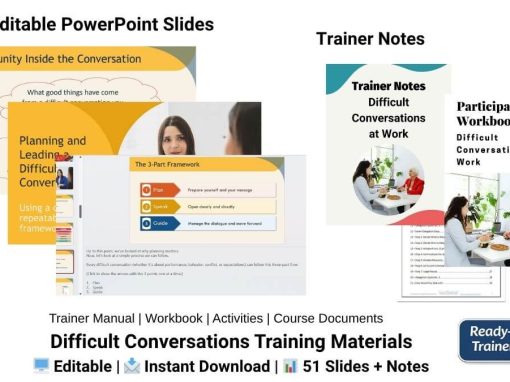
Communication & Interpersonal Skills Training Materials
Need ready-to-use materials for your own workplace training sessions?
- Fully editable PowerPoint slides
- Trainer notes and participant materials
- Ready-to-use activities, exercises, and handouts