
Both Sides of the Fence is a facilitated training activity where participants are asked to argue opposing viewpoints on the same issue, then reflect on what they’ve heard. It’s commonly used in workplace training to slow down judgment, improve listening, and surface assumptions.
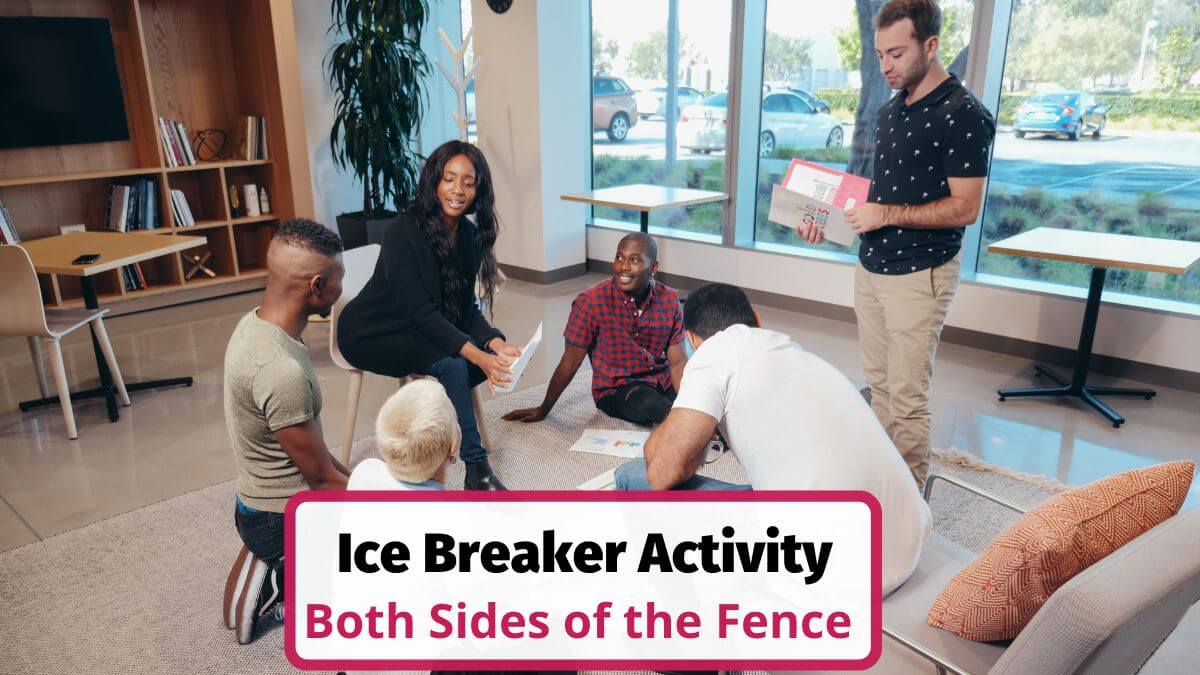
Both Sides of the Fence – At a glance
- Activity type: Trainer-led discussion exercise using opposing viewpoints
- Best used for: Communication skills, psychological safety, and balanced decision-making
- How it works: Participants argue assigned positions while a neutral listener summarizes key points
You can find our full range of group icebreakers for workplace training, designed to help trainers, facilitators, and HR teams, on our icebreakers hub.
How Long Does the Both Sides of the Fence Activity Take?
The Both Sides of the Fence activity typically takes between 20 and 75 minutes, depending on group size and discussion depth, and it is free to use.
How Many Participants Does This Activity Work For?
This activity is flexible and works well with small or large groups, as long as participants can be divided into groups of three.
What Is the Purpose of the Both Sides of the Fence Activity?
The purpose of the Both Sides of the Fence activity is to encourage facilitated discussion and structured dialogue around opposing viewpoints.
It helps participants practise active listening, explore trade-offs, and move towards more balanced decision-making.
Reflection and discussion – participants will discuss both sides of an argument, focusing on the positives and negatives of each position.
How Do You Run the Both Sides of the Fence Activity?
This is a trainer-led, step-by-step activity that uses role assignment and timed discussion to keep conversations focused and psychologically safe.
Step 1
- Depending on the topic you want to cover, come up with a number of dichotomies containing conflicting advice related to that topic. For best results, come up with at least 12 dichotomies.
Examples of simple dichotomies you could use include:
- Speed vs quality
- Consistency vs flexibility
- Autonomy vs control
Step 2
- Introduce the topic and the conflicting dichotomies to your participants.
- Explain that different guidelines can make sense in different contexts.
Step 3
- Ask participants to form groups of three.
- If two participants are left over, they can form a group of three with you.
- If there is only one participant left over, s/he can play the part of the observer.
Step 4
- Ask participants to choose one of them to be the neutral listener for the first round.
- The other two will be, respectively, the right and the left advocate.
- Explain that the left advocate for each round will become the neutral listener for the following round.
Step 5
- Explain that the neutral listener’s role is to listen attentively (and actively by maintaining eye contact, nodding, and smiling) to each advocate.
- The neutral listener, though, is not allowed to express any opinion in favor of or against the argument that the advocates put forward.
Step 6
- The role of each advocate is to be assigned one side of the dichotomy and give a presentation defending their assigned position while attacking the opposite position.
- The first advocate will talk for 60 seconds, after which the other advocate will speak.
- The advocates have 30 seconds to prepare their short presentation beforehand.
Step 7
- As a trainer, you will be the timekeeper.
- So, you will give advocates 30 seconds to prepare and blow a whistle at the end of the 30 seconds.
- Then, time 60 seconds for each presentation, and blow the whistle at the end of each presentation.
Step 8
- After the advocates have both presented their arguments, select a neutral listener at random and ask them to summarize the key points of both presentations
Step 9
- Continue the same process for other dichotomies.
- Announce the second dichotomy and ask participants to swap roles.
- So, the left advocate from the previous round will be the listener, the right advocate will become the left advocate, and the listener will be the right advocate
Step 10
- Repeat the same process with every dichotomy
Step 11
- You can also encourage participants to come up with their own additional dichotomies.
Step 12
- Conduct a class debrief at the end to summarize the discussions.
This stage often reveals how quickly we form judgments based on partial information.
In practice, using a structured communication checklist can help teams step back and identify whether a disagreement is truly about communication or driven by other factors.
The Both Sides of the Fence activity is often used in workplace communication skills training, particularly when teams need to practise listening, explore differing viewpoints, or discuss complex issues constructively.
For trainers delivering in-house workshops, structured discussion activities like this work particularly well when combined with clear facilitator guidance and ready-to-use communication skills training materials, and when integrated into a broader communication skills session.
Trainers often find that this structure works well even with quieter or initially resistant groups, as the roles provide clear boundaries and reduce pressure to share personal opinions.
What Are the Benefits of This Icebreaker?
- This activity promotes deep learning by encouraging discussion.
- This is an exercise that gives participants a chance to contrast, compare, and make connections within the topic at hand.
- Easy to run and tends to get good feedback from participants.
If you are building a longer training session, you might also want to combine this exercise with other structured discussion formats, such as our decision-making activities for employees, problem-solving activities, or goal-setting activities, which work particularly well later in a workshop.
When to use this activity
This exercise works particularly well when teams are dealing with workplace conflict, navigating change, or need to explore sensitive topics without discussions becoming polarised.
It is also effective early in a workshop to surface assumptions before moving into skills training.
What this activity is not
Both Sides of the Fence is not a debate competition or a therapy exercise.
Participants are asked to explore assigned positions rather than defend personal beliefs, which helps keep discussions constructive and focused.
Using This Activity in Communication Skills Training
If you are a training facilitator or freelance corporate trainer, we have a range of communication skills training materials and topics that we sell and that are instantly downloadable.
Topics that we find are in great demand, and that can be great courses to run as a freelance trainer are:
- Intercultural Communication Skills
- Psychological Safety
- Active Listening Skills
You can learn more about these materials via the banner below:
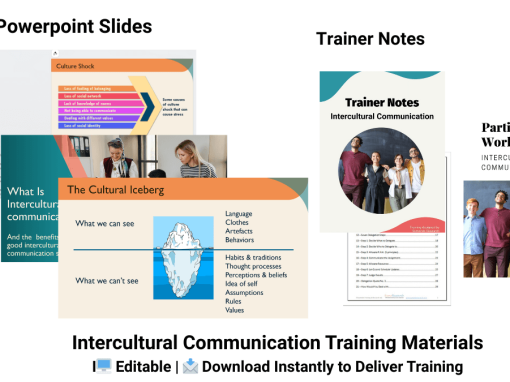
Ready-to-Use Communication Skills Training Materials
- Fully editable PowerPoint slides
- Trainer notes and facilitator guidance
- Built-in activities, handouts, and participant exercises


