Cognitive load in workplace training is the mental effort we use in working memory. How training is designed greatly impacts whether cognitive overload occurs. By avoiding clutter (extraneous information), including germane load (ways to remember what we are learning), and designing around intrinsic load (the complexity of the learning), we can make training more effective.

Cognitive Load at a Glance for Trainers
- Working memory is limited and easily overloaded
- There are 3 types of cognitive load: Intrinsic, Extraneous, Germane
- Excess cognitive load reduces retention and workplace application
- Better instructional design improves performance
- The Reduce–Sequence–Reinforce model helps prevent overload
What Is Working Memory in Workplace Training?
Working memory in workplace training is when we are learning and use a part of the brain to hold information temporarily while we process it.
Working memory is limited in capacity. When we exceed that capacity, learning slows down or stops.
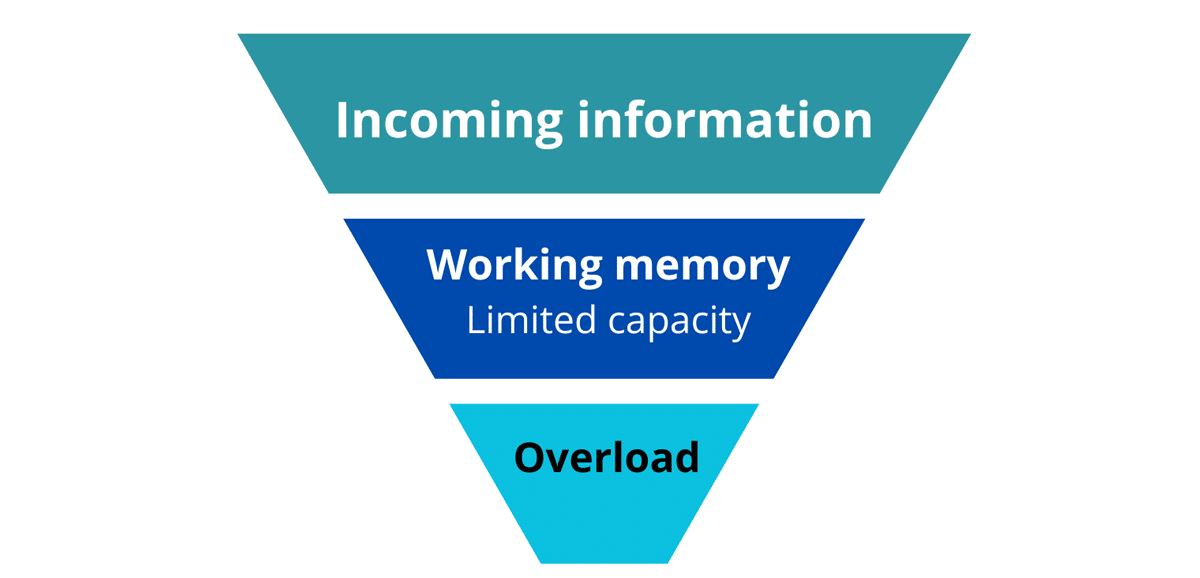
Imagine running a compliance training session where you are shown 40 slides that are delivered in 60 minutes. The slides include everything from policies, definitions, legal terms, and processes — and all at speed.
Learners may nod, but very little sticks in their minds, and furthermore, the trainer might say: “This will all make sense when you review the slides later.” But most people never review the slides later on in reality.
What we must not do is assume more information equals better learning. To understand this properly, we need to look at the three types of cognitive load.
How Much Information Can Working Memory Hold?
Most research suggests working memory can hold between four and seven chunks of information at once, although this varies depending on the complexity of the topic being taught (intrinsic load) and the learner’s prior knowledge on the given subject.
When training exceeds this capacity, cognitive overload occurs and knowledge retention drops.
For this reason, breaking content into smaller parts, building ideas step by step, and revisiting key points over time so learners don’t feel overloaded, can be an effective way to teach.
These approaches are known as chunking, scaffolding, and spaced repetition and are useful when designing workplace training, because these approaches make it easier for learners to capture information as long-term memory.
What Are the 3 Types of Cognitive Load in Training?

There are three types of cognitive load, and these are Intrinsic load (task complexity), Extraneous load (poor instructional design), and Germane load (learning effort that builds understanding).
The three types of load come from Cognitive Load Theory, developed by educational psychologist John Sweller in the 1980s. The theory explains how instructional design affects the limited capacity of working memory and the transfer of information into long-term memory.
It remains one of the most influential frameworks in modern instructional design and workplace learning.
For further reading, see Sweller, J. (1988). Cognitive load during problem solving: Effects on learning. Cognitive Science, 12(2), 257–285.
What is Intrinsic Load?
Intrinsic load is the complexity of the material itself, and an example of this is if you imagine you were teaching employment law versus teaching someone how to use some basic features on MS Word. Teaching employment law is going to be more complex and difficult to teach.
What is extraneous load in training design?
Extraneous load is all about the unnecessary mental effort caused by poor design, and this is very common in instructional design.
You might see cluttered slides, unclear instructions, jargon unnecessarily used, or irrelevant stories used in the facilitator notes.
Many of these issues are common instructional design mistakes. You can explore them further in our guide on Instructional Design Tips for Trainers.
What is Germane load?
Germane load is an extremely useful type of load because it is what helps us remember what we’ve been taught. It is a useful effort that helps us build understanding.
Typical examples of using germane load include when we use practice activities, group discussion, and role plays in workplace training sessions.
To give an example of these three types of load in action, imagine a leadership training session for new managers. The Intrinsic load in this case might be to understand a feedback model (such as the feedback sandwich).
The extraneous load in this example might be that the slides for these new manager training sessions are designed with cluttered text and distracting animations. And the germane load in the training design might be the inclusion of group activities and role-plays based on the feedback sandwich.
Why Does Cognitive Overload Happen in Workplace Training?
Some common causes of overload in workplace training are dense, over-populated slides, the use of too many models and frameworks in the training, explanations that are too long, and not giving participants enough processing time.
Dense slides – Most mental overload is caused by design choices because too much information is added to presentations, such as too many images or text.
Too Many Theories and Frameworks – One main framework or model will usually be enough for one training session. Mix multiple theories, and the training can quickly feel overwhelming for participants.
Long explanations – Talking non-stop for half an hour without including activities, role plays, or a Q&A session for the learners, can make it very difficult indeed to focus on the learning.
No processing time – Taking a few seconds pause and leaving silence can stress new training facilitators, but for experienced trainers, silence can be a good processing time for learners. Do not be afraid to pause and give learners time to reflect on key points.
Is Cognitive Overload a Motivation Problem?
Even though cognitive overload is often seen as a motivation issue, it is rarely the case.
Cognitive overload typically occurs because the training is poorly structured or overly complex.
In workplace training, learners often struggle because too much information is presented in too short a timeframe.
In most cases, the issue is structural design rather than a lack of effort.
What is the Reduce, Sequence, Reinforce Model for Trainers?
This model reflects core instructional design principles, which focus on structuring information clearly, managing cognitive load, and sequencing learning to improve retention and performance.
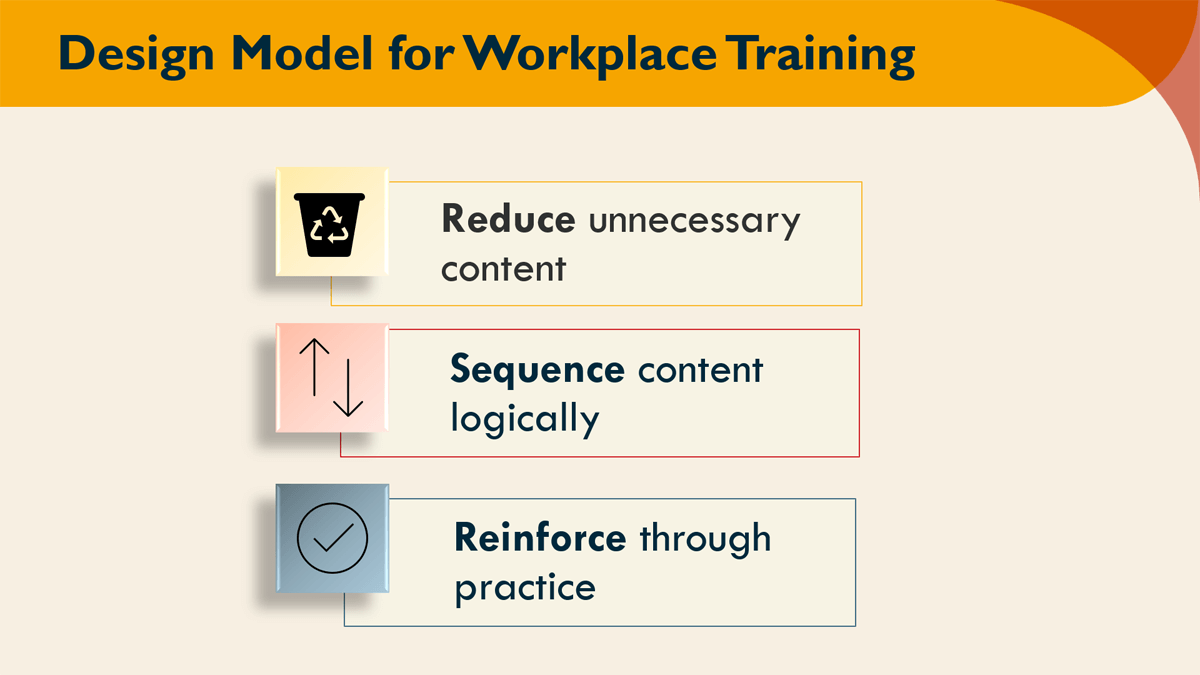
A good way to avoid extraneous load is to use the design model of Reduce, Sequence, and Reinforce. The design model can help you better structure training materials.
- Reduce: Remove anything that doesn’t directly support the learning objective. Ask yourself, “Does this help them perform better at work?”
- Sequence: Introduce ideas in a logical order. Build from simple to complex.
- Reinforce: Give structured opportunities to practise and reflect.
Example of How We Can Avoid Extraneous Load
For example, let’s imagine that you are running a feedback session in a workplace training session. So you do the following:
- Reduce: You choose to focus on teaching one feedback model only during the training to keep the training focused.
- Sequence: You explain the model and then demonstrate it.
- Reinforce: You then give the participants in the training session a chance to practice the model, such as by asking them to do a set of feedback role-plays, while using real workplace and realistic scenarios. After the role-plays, you might run a group discussion and debrief.
Action: What you wouldn’t do is explain the model and then simply move on. You explain the model and then give participants a chance to reinforce through practice.
What Mistakes Increase Cognitive Load in Corporate Training?
Four of the most common mistakes trainers make in instructional design are talking too much, over-explaining theory and concepts, skipping practice, and ignoring pacing.
Even experienced trainers increase cognitive load unintentionally through either poor instructional design in the first place or through getting distracted while giving training.
Talking for long periods without interaction – It is very easily done as a trainer, especially when first starting out as a training facilitator. The temptation can be to over-explain the ideas, topics, or research.
Session length and pacing also matter. You can read more in our article on Ideal Workshop Length for Workplace Training.
Skipping practice – Rushing activities because time is tight is a common issue in training, very often as a result of poor time management and planning. Practice is an important part of the Germane Load and helps learning be absorbed more easily by learners.
Ignoring pacing is most common with novice training facilitators, as there is often the feeling when starting out as a trainer that silence is awkward.
When used well, though, silence for a few seconds can be an asset because it provides reflection time and is great thinking time for learners. Do not try to fill every silence, and learn to be comfortable using silence as a tool for reinforcing ideas.
How Does Cognitive Load Affect Learning Retention?
Working memory is where we temporarily process new information. Long-term memory, on the other hand, is the knowledge that we store and are able to retrieve later on, such as when we need it for work tasks.
If working memory becomes overloaded, information cannot be transferred effectively into long-term memory, which is why learners often forget training.
By reducing extraneous load and building structured training that involves practice and reinforcement, it improves knowledge retention.
How Can Trainers Reduce Cognitive Load in Workplace Training?
Four ways to reduce overload in training design are to ensure you have clear aims and objectives set for the training, that the slide presentation is designed well without any extraneous load, comes with clear, structured facilitator notes, and includes realistic training room activities, exercises, and, if needed, roleplays.
- Clear objectives
- Designed slides
- Facilitator guidance
- Realistic scenarios
Bloom’s Taxonomy is also useful when planning training sessions, as it encourages you to move from helping learners understand a concept to giving them opportunities to apply it in practice.
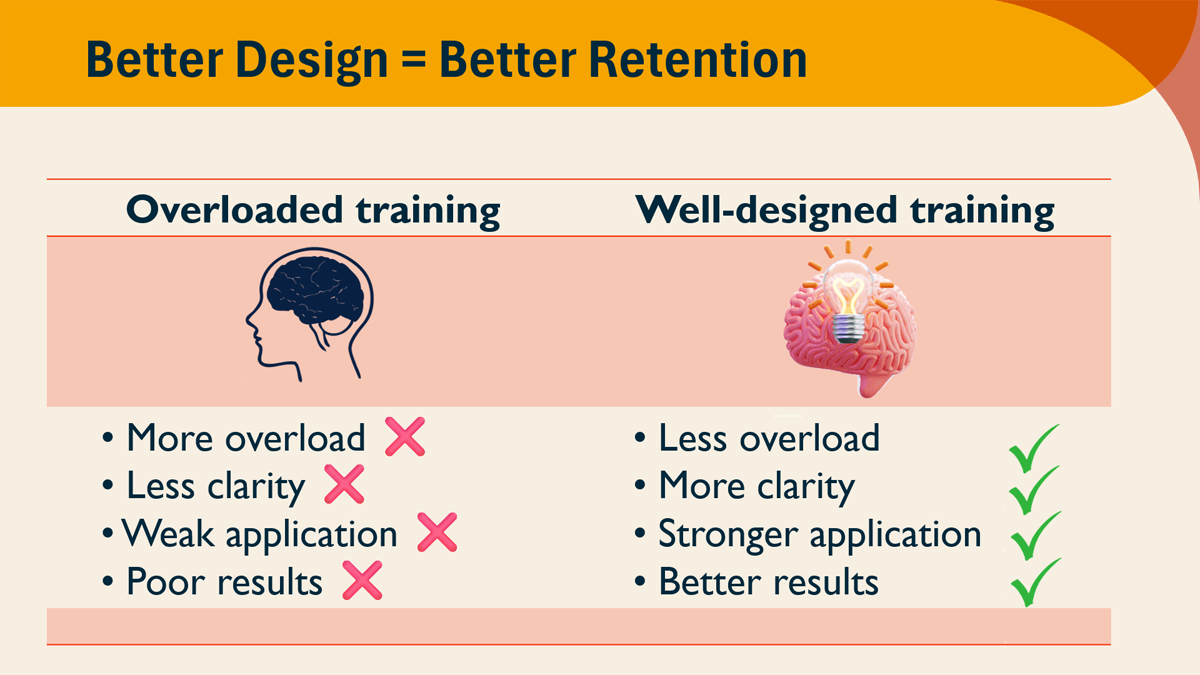
In essence, well-designed training materials will avoid overload, provide greater clarity, allow for greater application in terms of the skills learned, and enable better results.
With effective training, employees are more likely to become more engaged, be happier in their work, and, as a company, you will often see performance and productivity improvements.
If you want more ideas on how to design materials that reduce overload, see our Employee Training Materials Guides for Better Training and Development, with tips on how to structure content, slides, and activities effectively.
Why Do Employees Forget Training?
Employees often forget workplace training not because they weren’t paying attention, but because too much information is presented at once.
It is common for companies to assume that employees forget training because they lack motivation or because they lack focus. This is often, though, not the case.
When too much new information is presented at once, working memory cannot process and store it effectively.
Once working memory is overloaded:
- Information is not absorbed properly
- Key connections in learning are not formed
- Learning does not transfer into a learner’s long-term memory
You may have left a training session feeling that you generally understood the topic, but still be unsure how to apply it to your actual work tasks.
This is not a motivation problem but a design problem.
If you can make the training more practical and relate to real workplace situations and workloads, as expressed in Adult learning theory (often referred to as andragogy), training becomes more relevant and leads to better knowledge retention.
Overloaded Training vs. Well-Designed Training
This is why professionally designed training materials structure content carefully, limiting theory overload and including practice activities at key points to reinforce learning.
If you want practical techniques that improve retention beyond reducing cognitive strain, see our guide on 10 Proven Strategies to Improve Employee Learning Retention.
In order to design effective workplace training, reducing unnecessary load, ensuring information is sequential, and that exercises and activities and other reinforcement methods are used in the training, will help knowledge stick.
Cognitive Load Checklist for Trainers
Before delivering your next session, pause and ask yourself:
- Am I trying to cover too many models in one session?
- Could any of this content be simplified or broken into smaller sections?
- Does the learning build logically from basic ideas to more advanced ones?
- Have I included opportunities for participants to practise and apply what they’ve learned?
- Is there enough time built in for reflection and discussion?
- Are any slides, examples, or explanations unnecessary?
- Have I reinforced the key message before moving forward?
- Am I limiting theory and prioritizing practical application?
Our ready-to-use course materials are structured around this exact checklist, limiting overload, sequencing content logically, and including practice activities.
Frequently Asked Questions
What is cognitive load in workplace training?
Cognitive load in workplace training refers to the amount of mental effort required to absorb new information, and whether too much pressure is placed on working memory, which can only handle a limited amount at one time.
How can trainers prevent cognitive overload?
When designing and planning training, avoid clutter and unnecessary content (including graphics and animations), follow clear aims and objectives sequentially, and include reflection exercises and activities, to make absorbing the learning easier for participants.
Do your training materials apply cognitive load principles?
Yes. Our editable training course materials are created in-house by Dr Valeria Lo Iacono and are designed with cognitive load principles in mind. They reduce unnecessary content, follow a clear sequence of objectives, and include structured activities to support learning.
Can I adapt your materials to my own training style?
Yes. All materials are fully editable in PowerPoint, allowing you to adjust pacing, examples, and activities to suit your specific audience while maintaining a clear and logical structure.

See Our Ready-to-Use Training Course Materials
- Fully editable PowerPoint slides
- Trainer Notes & participants guide
- Printable participant workbooks, handouts & activities in the PPTs