
If you’re running training for employees of different ages, here are 7 multigenerational training activities you can try. I’ve included everything from coffee chats and reverse mentoring to storytelling, panel discussions, travel stories, appreciation walls, and company history sessions.
The idea is to get colleagues talking, sharing their experiences, and learning from each other, so that they can better understand people from different generations.

Multi-Generational Training Activities
If you want to know more about what generational diversity is, make sure to read our previous post about how to manage generational diversity. In the meantime, here are the multigenerational training activities I promised you.
1. Generational Coffee Chats
Number of Participants: 4 or more people.
Time Needed: 30 minutes to 1 hour.
Items Needed: Nothing special is needed to run this activity.
How to Run the Activity: For this activity, I suggest putting employees into pairs, ideally with someone they don’t normally work with. If you know the team quite well, you might be able to pair people from different age groups or with different levels of experience.
I wouldn’t make a point of asking everyone which generation they belong to, though. You want people to relax and get to know each other, rather than worry about how old everyone is.

I suggest providing tea and coffee for everyone (if practical) to make this a relaxing activity so that colleagues talk more naturally, i.e., in a more relaxed manner.
The pairs will spend 10 minutes talking with each other, and they can discuss their work, hobbies, or life experiences. Anything they wish, really, although you might, as the training facilitator, wish to provide some cards with topics listed on them to guide them as needed.
You might also want to explain that whatever topic they do discuss, they should try to include a focus on something they learned, i.e., if talking about travel, something they learned about themselves, for example.
After 10 minutes, change the pairings and run this 3 times.
2. Reverse Mentoring
Number of Participants: 2 or more.
Time Needed: Time depends on the mentoring that is taking place, so it can vary greatly.
Purpose: This is a wonderful way to create trust and respect between colleagues from different generations and age groups.
How to Run the Activity: You might first want to read our post about reverse mentoring here, which explains in full what reverse mentoring is.
Reverse mentoring is when a less senior or less experienced employee mentors a more senior colleague in an area where they have particular knowledge or expertise. This can help employees from different generations learn from each other, but the mentoring should be based on skills rather than assumptions about someone’s age.
Now match employees who have different levels of seniority or experience. Where practical, you can bring together colleagues from different generations, but what matters most is that the mentor has a skill or knowledge that the other person would like to learn.
A good example might be a senior manager who has 25 years of experience but wants some help with social media marketing. A newer employee might be particularly good at using Instagram and Pinterest, for example, and could spend some time showing the manager how to use these platforms more effectively.
Remember, though, that this is not about assuming younger employees know more about technology than older colleagues. It’s really about making use of the different skills people have, whatever their age, and letting employees learn from each other.
As the training facilitator (or manager), identify the skills and expertise that employees have to offer, and then match less senior employees with more experienced colleagues who could benefit from learning those skills.
The mentoring can take place as often as needed, be it once a week or as a monthly session. Do whatever is suitable.
In team meetings, you might also want the pairs to share their thoughts on the experience with the rest of the team to further promote team appreciation.
Reverse mentoring can be a great way to encourage knowledge sharing between different generations and help colleagues develop more respect for each other.
You can also see our 10 mentoring activities for workplace training, including mentoring circles, job shadowing, and mock mentoring sessions.
3. Generational Storytelling
Number of Participants: 6 or more people.
Time Needed: 30 to 60 minutes.
Purpose: This is one of the simplest cross-generational training activities you can run, and participants often find it quite interesting, thought-provoking, and enjoyable.
How to Run the Activity: For this activity, bring together employees from various generations and age groups into a one-hour storytelling session.
If you are a large group, you might want to split participants into 2 or 3 small groups, but do ensure that you equally divide up participants so that you spread out people from different generations into each team.
Now allocate 5 minutes for each person in the group to tell what they consider an interesting story about themself, be it connected to work or something they have achieved or love doing outside of work.
Ask the participants to try to tell a story that will provide the others listening with an insight into who they are and what shaped their way of thinking, i.e., shapes their perspective and character.
4. Generational Panel Discussions
Number of Participants: 10 or more.
Time Needed: 1 hour.
Purpose: Cross-generational panel discussions are great for facilitating the sharing of different perspectives from employees from different generations in the workplace.
How to Run the Activity: Organize a panel discussion for one hour, where employees from different age groups discuss things as a group. You can, for example, have 6 people on the panel and 14 audience members, if you were a team of twenty employees.
The audience should feel free to ask questions and add to the dialogue.
It is up to you what the panel will discuss, but you could make it topical, such as future trends in your industry or something that matters to the future of your business.

View the Cross-Generational Training Materials
5. Intergenerational Travel Stories
Number of Participants: Ideally, 5 or more participants.
Time Needed: 1 hour (but 2 hours if needed).
Purpose: While this might seem like a very basic concept for a multi-generational training activity for employees, it does actually work very well because so many of us love travel (be it domestically or abroad).
It’s interesting to hear where colleagues have traveled and what they remember about those trips. People often have very different stories to tell.
Items Needed: Nothing special is needed.
How to Run the Activity: It can be worth letting the participants know in advance that they will be telling a story about a travel experience so that they have the chance to bring in photos (printed or digital) and souvenirs or mementos as needed.
You might also want to explain in advance that the story they choose should ideally include some cultural influence, i.e., something they learned that made the experience memorable and especially interesting.
For the activity itself, each participant will spend 5 minutes talking about their memorable trip.
While this activity can also be great practice in terms of presentation skills, the talks can be quite casual, i.e., the speaker can remain seated with the group rather than have to stand at the front of the classroom (unless they wish to present on a projector, etc).
The focus is on the content rather than presentation skills for this activity.
After each 5-minute talk, the other participants can ask questions about the trip, and an open discussion can take place for 5 minutes more.
If you have a lot of participants, you can divide the class into two or more groups, but if doing so, make sure to divide people such that different generations are represented in each group.
To end the activity, you, as the training facilitator, might want to just highlight some of the main takeaways from the stories, i.e., the common themes that emerged.
Encourage participants to continue exploring and chatting about these travel experiences in the future.
6. Generational Appreciation Wall
Number of Participants: Unlimited.
Time Needed: Ongoing.
Purpose: This exercise helps colleagues appreciate each other more and can be a useful way to encourage a more age-inclusive workplace.
How to Run the Activity: This is a cross-generational variation of the ‘Appreciation Wall’ concept, and rather than a classroom activity, this is more of an ongoing exercise.
For the Generational Appreciation Wall, you set up a wall (i.e., a large board on a wall where colleagues can post photos, pictures, text, and cutouts such as newspaper clippings).
The board can be used to post things about yourself, i.e., something interesting you have been involved with/or achieved in the past, or something positive that you want to say about a colleague.
As a manager, though, you would ask everyone to contribute to the board and to do so in a way that whatever they add to the board adds something positive in nature and has some generational context.
Some examples:
- You are now in your seventies and still working in the office, but as a youngster in your twenties, you sailed across the Atlantic as part of a sailing race (so you put a news clipping on the board about it).
- You are just out of college as an 18-year-old and recently joined the company, but in college, you were involved with the arts and are quite talented in painting (even though your job is in marketing), so you post a couple of photos of your art with a description about the art underneath them.
- It might be that you are an employee who, in your spare time, works for a local animal shelter, and so you post photos of yourself at the shelter, highlighting the work you do there, in addition to working in your daytime job.
The generational wall is designed to give colleagues a chance to appreciate each other more and to showcase their skills, hobbies, and interests.
Try to position the board in a high-traffic area so that colleagues use the board as an ongoing exercise.
7. Company History Session
Number of Participants: No minimum.
Time Needed: 1 hour
Purpose: This is a great multi-generational activity for sharing a little more information about the company’s culture and history and, in particular, more about those people still in the company who play a part in this history.
How to Run the Activity: Organize either a talk about the company or a tour of the office with long-term employees sharing the history and significant milestones and changes that the company has experienced.
What role did these long-term employees play, and how, for example, has technology changed in that time?
End the guided tour with a question-and-answer session so that participants can dig deeper into the company’s history. Consider creating a timeline display in a common area that visually represents the company’s evolution.
For more ideas on building an inclusive workplace, explore our DEI workplace guides and training activities.
Cross-Generational Teaching Materials
The benefit of teaching employees about cross-generational and multi-generational solutions, issues, and factors in the workplace is that you help employees see the benefits that different generations can provide them.
Someone who has worked for a company for 20 or 30 years will often know things about the business that a newer employee has yet to learn.
But it can also work the other way around. Someone who’s only recently joined the company might have certain skills that even the most experienced managers don’t have. This is why it’s worth getting employees of different ages and backgrounds to share what they know.
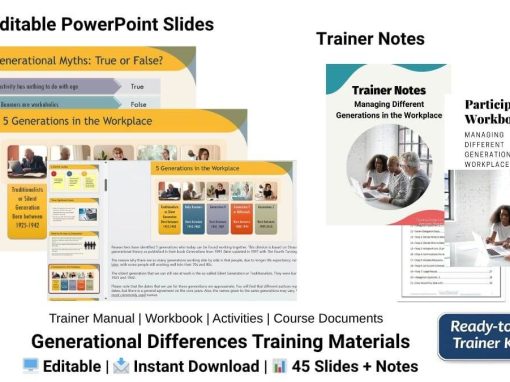
See the Generational Differences Training Materials
- Fully editable PowerPoint slides
- Trainer Notes & participant guide
- Printable participant workbooks, handouts & activities in the PowerPoint slides
As a trainer, you may also find our guide to the main challenges of managing multigenerational teams useful. We have more free team-building activities available for you to use. If you are also interested in Workplace Wellness Guides, do check the wellness hub.


