Most of us get distracted at work from time to time, whether it is because of emails, phone notifications, background noise, or simply feeling tired or stressed. By identifying the things that distract you most, you can start making small changes that make it easier to concentrate and get important work done.

By better understanding how we get distracted, we can better apply strategies to reduce these distractions. In many organizations, these small daily interruptions quietly add up and affect deadlines, the quality of work, and employee engagement and stress levels.
Research on workplace interruptions shows that even short distractions can interfere with task performance and make it harder to resume the original task efficiently. This repeated switching between tasks can have a strong cumulative impact, resulting in notable productivity loss and reduced work quality.
Quick Summary: How to Avoid Workplace Distractions
- Identify the main causes (digital, environmental, internal)
- Reduce interruptions by batching tasks
- Schedule email and message checks
- Protect deep work time
- Use structured focus strategies daily
This guide is one of our Workplace Wellness Guides for Trainers and HR Professionals, where we look at stress, resilience, burnout, and practical digital well-being strategies in more depth.
A Simple Framework for Reducing Workplace Distractions
A very useful four-step framework you can use for reducing workplace distractions is Identify → Reduce → Protect → Reinforce.

Identify → Reduce → Protect → Reinforce
1. Identify
You start by first identifying the main distractions you are regularly impacted by. Are you checking your emails just far too often? Do you always feel the need to instantly respond to notifications on your phone or computer?
Are you affected easily by working in an open-plan office because of noise? Or perhaps you push too much for perfectionism, or do not have focused and clear goals?
2. Reduce
Once you have identified the main distractions, the next step is to create new habits that reduce the negative impact of the distractions.
You can, for example, turn off non-essential notifications, only check emails once every 2 hours, or use noise-canceling headphones. Likewise, you might choose to break large tasks into smaller time-bound steps.
Small environmental and behavioral adjustments can greatly reduce cognitive load.
3. Protect
The next step is to work to protect your uninterrupted focus time.
Schedule blocks of time for working on important tasks, where you need to focus.
Frequent interruptions create what is known as “attention residue“, meaning it is harder to return to high-concentration tasks when distracted.
Protecting key focus time is not about working longer, but working with fewer interruptions, i.e., working smarter.
4. Reinforce
Finally, you need to reinforce the habit daily.
Review priorities each morning, evaluate what distracted you at the end of the day, and make adjustments the next day as needed.
Over time, consistent focus habits reduce productivity loss and support sustainable performance.
What Are the Main Types of Workplace Distractions?
The three main types of workplace distractions are digital, environmental, and internal.
If you’ve ever found yourself checking emails every 15 minutes, then you’re not alone. Most workplace distractions fall into one of these three areas: digital, environmental, and internal. Once you know which type you’re dealing with, the solution becomes much clearer.
| Distraction Type | Example | Solution |
|---|---|---|
| Digital | Email notifications | Schedule specific times to check emails |
| Environmental | Open-plan offices, background conversations, and even constant movement in your peripheral vision can impact your attention span. | Noise-canceling headphones |
| Internal | Fear of making mistakes | Break tasks into smaller, time-bound steps |
Imagine starting a report, then deciding for some reason to check your emails. And before long, the report is open on your screen, but you’ve almost completely forgotten that you’re meant to be working on it. Another email drops into your inbox, and you answer it. Before you know it, it’s been 15 minutes since you last worked on the report, a report that just happens to be quite urgent. Over the course of a week, these types of distracted moments build up. Emails are perhaps one of the biggest causes of distraction in the workplace.
Most workplace productivity challenges can be traced back to one of these three distraction types.
Why Do I Get Distracted So Easily at Work?
If you are getting distracted incredibly easily at work, do not worry, as you are certainly not alone.
Technology is a major source of workplace distraction in that we now have access to the Internet while we work, we have our smartphones beside us, and then emails and a range of communications, including team messaging apps and other communication tools.
Given how easily we can access technology throughout the workday, it is unsurprising that distractions are so common.
In essence, our cognitive load (the mental effort we use to process information) is high when we are not only trying to do a main task but also thinking about emails, notifications that ping on our phone, or digesting conversations that are going on around us. This all makes it harder to prioritize effectively.
How to Stay Focused at Work?
There are several ways to focus and reduce workplace distractions, and these include setting specific goals, learning to say no to some tasks (at least in your personal life), taking regular breaks (to refresh the mind), avoiding regularly checking emails and social media, and batching similar tasks.
How Can You Avoid Workplace Distractions? 12 Practical Strategies
Recognizing the patterns behind workplace distraction allows us to move from awareness to action. The following 12 strategies provide structured ways to reduce task switching and improve sustained focus.
1. Check Emails at Specific Times Only & Turn Off Notifications
Emails can be extremely distracting; I think you’ll agree.
Sometimes we use emails as an excuse to procrastinate or as a type of gratification, as checking emails makes us feel as though we are doing something, and we are in touch with the outside world.
By all means, check emails, but why not choose specific designated times, such as first thing in the morning and then an hour before the close of business?
This way, you will not disrupt your focus when you are working on a task that requires concentration.
2. Allocate Large Chunks of Time to Important Tasks
If you want to focus and enter a state of flow with your work, it is important to allocate large chunks of time to the most important and hardest tasks.
Author Cal Newport describes this kind of uninterrupted concentration as “deep work”, meaning periods of focused effort without distraction that produce higher-quality results.
Continuous interruptions are bad not only because of the time taken during the interruption itself, but also because it usually takes time to get back into what we were doing before.
When you jump between tasks, part of your attention often lingers on what you were doing before. Psychologists often call this the “attention residue,” and this residue can make it harder to settle properly back into the next piece of work.
If you need to refocus and gather your thoughts again after each interruption, you will never work at your full potential.
3. Complete the Most Important Task First
It is so easy to choose and tackle the small, quicker, and easier tasks first at work.
There is often a sense that the more tasks we get done, the better we are doing.
The problem with this, though, is that tasks that are more important end up continually getting pushed down the road.
After checking emails and doing 1 – 3 quick and easy-to-complete tasks, tackle one big task head-on!
If you finish before the day’s end, then you can easily get some more small tasks done.
4. Take Regular Breaks
This point might seem to run contrary to the idea of getting more work done.
Take breaks to avoid burnout and look after your mental well-being.
Rather than the amount of time we spend working on a task, it is as much about the quality and productivity levels we have while working, and breaks can greatly aid these productivity levels.
If stress is affecting concentration levels, structured stress management techniques can also help.
5. Learn How to Say ‘No.’

Learning how and when to say ‘no’ is also extremely important.
Even outside of your work, saying ‘no’ is, for many of us, the most difficult thing to do because we feel guilty or because we feel that we may miss out on something (FOMO) or let other people down.
In a work situation, we have to, of course, do what our superiors ask us to do, but there are many other work situations when we DO have a choice and can say no.
It is essential to always keep an eye on the big picture so that you focus on what helps you achieve your goals.
Do not feel guilty if you have to say ‘no’ more often to requests from colleagues that would otherwise be a real distraction for you and that are not essential.
Likewise, if you work from home, do not be afraid to say no sometimes to family or friends if the request does not support your goals or the direction you want to take.
6. Organize Your Workspace and Materials
Another handy technique is to gather all the materials together that you need for a task and move all irrelevant materials away.
If you gather all the materials you need together, you will not waste time looking for them.
Similarly, everything you need will be easier to find if there is no clutter in the way, acting as a distraction.
You can extend this idea to making sure that your desk and work area are free of clutter and distractions!
A clear workspace helps you to keep a clear mind and, as above, to find everything you need faster.
Organizations increasingly use structured time management and digital well-being training to reduce distraction-driven productivity loss.
If you’re delivering workshops or internal training, you can explore our fully editable digital well-being training materials here.
7. Put Your Cell Phone in a Drawer or Bag

You naturally will want to keep your phone within reach so that if it rings, you have the chance to answer it.
So many of us also get so easily distracted by text messages and apps on our phones that we spend countless minutes (and sometimes hours) using our phones unnecessarily.
If having more focus and getting more work done is what you are looking to achieve, and if your personal phone is not central to your job, hide it away for a few hours. Stick it in a drawer, for example!
8. Use Music to Get in the Groove
Provided you do not need to answer phones, consider using relaxing music and headphones to put yourself into a relaxed state, such that you get into a flow with your work.
Instrumental music can be especially good (try Ludovico Einaudi), and if you work alone, consider a pair of noise-canceling headphones.
Whatever music works best for you, get into the flow, relax, and be productive.
9. Avoid Social Media During the Workday
Social media is one of the biggest distractions in terms of how we lose time and get distracted and unfocused.
There is, of course, nothing wrong at all with using social media, but unless it is part of your job, allocate a certain time for checking social media.
You might want to have 15 minutes at lunchtime to check your Facebook, Twitter, or Instagram, but also do not forget to try to use your breaks to move, as discussed in the next point.
10. Moving and Staying Healthy
When we feel healthy and relaxed, it is far easier to be more focused and productive.
One of the best things you can do is to make sure to move, i.e., stand up and go for a short walk during your breaks.
Even if it’s just walking up a few flights of stairs or walking around the block. Regular movement can help our general health and help us feel more alert.
Moving even just a little bit more each day can have great health benefits, and when you do get back to work, you will feel more energized.
11. Batch Similar Tasks Together
Dealing with similar tasks one after the other can help, as we may need similar resources for each, so we can double up or find everything we need more easily.
Batching together similar tasks is one of the easiest ways to avoid workplace distractions, as in between tasks, we can very easily end up interrupting our train of thought and losing our work rhythm.
Research has shown that multitasking tends to be less efficient and reduces overall productivity compared to working on a single task and focusing on it.
12. Have Clear Goals and Avoid Perfectionism
It is hard to be productive if you do not have clear goals and a vision of what you want and need to achieve.
Set clear goals for the day and week.
Furthermore, to avoid workplace distractions, you need to avoid thinking that you can always be perfect in your work. Perfectionism can stop you from completing a task in time.
Do your very best, but also accept that sometimes, to get tasks completed, we have to keep moving forward.
Building resilience skills can also help reduce distraction caused by stress and overwhelm. You may find these resilience activities for workplace training helpful if you are delivering workshops or supporting employee well-being initiatives.
Workplace Focus Checklist
Use this quick checklist to reduce daily distractions:
☐ Identify your top distraction this week
☐ Schedule email checking times
☐ Block 60–90 minutes of deep work
☐ Batch similar tasks
☐ Remove one environmental distraction
☐ Review goals daily
Want a printable version?
👉 Download the Workplace Focus Checklist (PDF)
Keeping Focus at Work: Final Thoughts
In addition to directly thinking about how you can minimize distractions at work, also think in terms of creating positive habits that you can build into your workday to minimize distractions and improve your productivity.
For example, to avoid getting so easily distracted by emails (as discussed earlier), set in place a time when you will check emails, such as at the start of work, after lunch, and then before you leave work.
Likewise, you might want to include some time management techniques into your workday, in addition to placing your smartphone in a drawer and following through on a task to completion at least once a day.
While focus starts with individual habits, it’s also influenced by how our work is organized. Clear expectations around meetings, email response times, and workload management make it easier for people to concentrate consistently — not just occasionally.
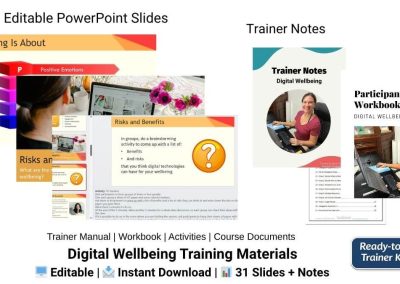
Need Ready-to-Use Digital Wellness Training Materials?
Save hours of prep time with our professional PowerPoint course kits — perfect for trainers, HR professionals, and team leads.
Frequently Asked Questions About Workplace Distractions
What are the most common workplace distractions?
The most common workplace distractions include checking emails way too often, looking at digital notifications (such as messaging apps and social media), workplace noise (such as other chatting or talking on the phone, especially in open-plan offices), interruptions from colleagues, trying to multitask, and not having clear goals.
How do workplace distractions reduce productivity?
When we get distracted at work, we experience what is known as attention residue, which means we are still focused on a previous task rather than focusing on the present one. This increases cognitive load and makes concentrating harder, and over time, we lose a lot of time and produce lower-quality work.
How can managers reduce distractions in teams?
Managers can help by reducing workplace distractions, such as by setting clear goals and expectations for those they manage, in addition to limiting unnecessary meetings and providing their team with time management and digital well-being training.
Can training help employees stay focused at work?
Yes. Structured time management and digital well-being training are useful for helping employees understand how to develop practical strategies for reducing distractions, such as by batching tasks, using focused work time, and building sustainable focus habits.
Why do I get distracted so easily at work?
Modern workplaces are highly digital environments, and with the constant flow of information, we are in what can be termed ‘interruption-driven workplaces’. There are emails, smartphones, messaging tools, online meetings, and so much more that can impact our cognitive load. For this reason, we might switch tasks often and lose focus easily.