
When an employee comes back after a period of absence, a return-to-work interview helps both the manager and employee discuss any ongoing concerns, identify any adjustments that may be needed, and plan a successful transition back into the workplace.
Employees may return after illness, injury, maternity or paternity leave, or another extended absence. A well-planned return-to-work interview helps employees feel supported, identifies any workplace accommodations that may be needed, and ensures managers can address any concerns before the employee resumes their normal duties. Understanding the underlying causes of absenteeism can be extremely useful as a manager.

Having a proper system in place for staff who are returning to work after a long absence can be good for a business in a number of ways, including because it can help:
- Help employees feel valued and reduce future absences
- You meet legal obligations such as requirements under the Equality Act
- Support employees appropriately and responsibly
So what is the best strategy for managing a staff member returning to work after an absence?
The first thing to do is to have a return to work interview. There are 6 steps that I recommend you take during the interview, and these are shown and explained below!

1. Welcome the Employee Back to Work
Start by welcoming the employee back to work and then conduct a return-to-work interview with them at the earliest possible opportunity.
To start the interview, welcome the employee back to work again.
The tone of the interview as a whole needs to be positive. Also, use the interview to give the employee a chance to explain the reasons for their absence.
You can also use the interview to assess whether the employee is fit to return to work and whether any additional support or workplace adjustments are needed.
This can help you reduce the chance of future additional absence days.
2. Update The Employee
Next, bring the employee up to date with any changes or events that occurred during their absence.
This will help make them feel included.
3. Identify Adjustments
Find out if there are any reasonable accommodations that need to be made to make it easier for the employee to transition back to work.
4. Make a Transition Plan for the Employee
If adjustments are needed, the line manager should create a plan with the employee to set out how they will be transitioning back to work.
Transitions can, for example, include the employee doing easier tasks that will involve less pressure on them to start with. Likewise, if the employee is returning after an accident, you might want to give them lighter duties to start with.
In some cases, a phased return to work may be appropriate, with employees gradually increasing their hours or responsibilities over time.
5. Record Absence Dates
Make sure that the absence dates have been recorded and check with the employee that they agree on the dates, in case there are any disputes later.
6. Open for Questions
Let the employee ask you any questions they may have and/or express any concerns that have not been covered.
What Are the Best Return-to-Work Interview Tips?
If you are wondering how to conduct a return-to-work interview, I recommend following these tips:

1. Hold the interview in private
This is important as you have to ensure confidentiality.
Similarly, make sure that any forms and documentation you prepare are kept confidential and stored safely, in line with data protection regulations.
2. Be objective
Do not let any personal feelings or biases interfere with the interview, and try not to be judgmental.
The language you use is also very important. So, for example, if you notice that the employee is always absent on a Friday, do not say: ‘You are always off on Fridays. That’s very strange, don’t you think?’
A question like this will only put the employee on the defensive. Say something like: ‘It seems that your absences occur mainly on Fridays. Do you know why that is?’
3. Ask open-ended questions
The interview has to be a positive experience. Open questions, which do not require a ‘yes/no’ answer, will allow the employee to open up.
4. Listen and show interest
Show genuine interest and make the employee feel that they are being listened to and that you care.
5. Be empathetic
Show understanding and empathy for your employee. Make it clear that you wish to support them at work.
Some problems can be pretty worrying for people, so you want to make employees feel valued, support employee wellbeing, and avoid adding further stress.
6. Tell the employee they were missed
This is important to make them feel valued.
7. Do not try to instill fear
The return to work interview should be a positive experience, not an interrogation where the employee feels that they have to defend themselves.
8. Keep a record of the meeting
This is important to spot any absence patterns, not so much for disciplinary procedures (although, unfortunately, that may be the case in some rare circumstances) but because sometimes absence patterns can reveal underlying problems or conditions that an employee may need support with.
Keeping accurate records also supports effective absence management and helps identify recurring absence patterns.
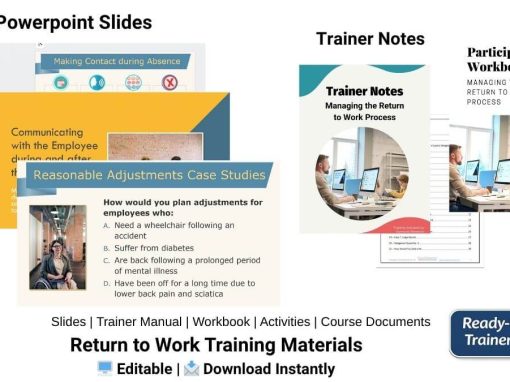
See Our Return-to-Work Training Materials
- Fully editable PowerPoint slides
- Trainer Notes & participants guide
- Printable participant workbooks, handouts & activities inthe PPTs
What Questions Should You Ask During a Return-to-Work Interview?
Here are some questions you might want to ask during the return-to-work interview.
1. How are you feeling?
This is the most important question, as you want to assess if the employee is fit to be back to work.
If their absence was not due to sickness, you may still want to ask how they feel about being back to work or other open questions to assess their state of mind.
2. What fact-finding questions should you ask?
These are straightforward questions, particularly if the absence was due to sickness.
It can be helpful to know information such as if they saw a doctor; if they are taking any medications; and how these are affecting them (in case these have an impact on their job, meaning that adjustments to their workload or the nature of their work might be needed).
3. How are you finding your workload?
You can directly ask the returning employee so that you can find out if you need to lighten their workload temporarily.
4. How can we best support you?
To find out anything that might help them transition back into work.
5. Tell me about your work relationships with your colleagues
This one (or another open question along these lines) could be a useful question if you suspect that their absence may be due to conflict or bullying/harassment they may be experiencing at work.
You also want to avoid the opposite of absenteeism, and that is presenteeism. Learn more about presenteeism and also take a look at our employee engagement workplace guides.
FAQs
What to expect from a return to work interview?
Do not be concerned, as a return to work interview is aimed at helping you smoothly adjust and get back into the work process. It gives the employee a chance to understand anything you might need and ways they can help you.
What questions to ask in a return to work?
If you are holding the interview as a manager, ask questions that help you to understand any way that you can assist the employee. Ask if they have any specific needs, such as adjustments because of medication or physical impairment.
What do you say when returning to work?
First, make sure to welcome the employee back and to make clear you are happy to see them. Set a positive tone. Then ask questions such as how they are, if they have any specific needs, and what you can do to help them transition smoothly.
Are return-to-work interviews mandatory?
Return-to-work interviews are normally a choice and not all companies provide them. These interviews can benefit both the employee and you as a company.
How long should a return-to-work interview take?
Most return-to-work interviews last between 15 and 30 minutes. However, employees returning after a long-term illness or injury may need a longer discussion to review any workplace adjustments or agree on a phased return to work.


