These dealing with difficult people training activities and exercises give employees a chance to practice how to respond to challenging behavior at work.
The five activities below can be used whether you are a trainer, HR professional, manager, or training facilitator. You can use one activity on its own or combine several of them as part of a longer session. The choice is yours.
The activities cover different aspects of dealing with difficult behavior, including noticing what is actually happening rather than making assumptions, managing their first reactions, communicating assertively, and setting appropriate boundaries.

How Do You Use Difficult People Training Activities in a Workshop?
All of these activities work well when used with small groups, and they can quite easily be adapted to suit the needs of your participants. Do, though, allow some time after each activity for a short debrief and discussion so that participants can reflect on what happened, discuss different responses, and consider how the learning could apply in a real workplace situation.
1. From Labels to Observable Behavior
Purpose of the Activity
This activity represents a first step in dealing with people we find challenging.
We shift from judging personalities and thinking “that person is difficult” to focusing only on their observable behavior.
So, the question is no longer “How do I deal with this difficult person?” but “What specific behavior am I dealing with?”
This mental shift helps us reduce assumptions and can reduce some of the emotional charge associated with the label.
Also, if we focus on a specific behavior rather than trying to change a person, the problem becomes more specific and something we can act on.
This is why this activity provides the foundation for later communication activities, because we place greater emphasis on what can be observed before interpreting it.
We shift our focus to what is actually happening or what just happened rather than what this might mean about a person.
Time Needed: 20–30 minutes.
Number of Participants: People can work on their own to begin with, then get into pairs or groups of three or four.
What You’ll Need: Make a list of about 6–10 words that people might use when describing a colleague they find difficult. For example, someone might be called rude, lazy or uncooperative. You can show the words on a PowerPoint slide, write them on a flipchart or put them on separate cards. Give everyone some paper so they can think of specific things a person might say or do that would lead to those descriptions.
Skills This Activity Helps Develop
This mental shift can support how we deal with situations in general.
So, if the participants engage in this activity, they can get better at a range of skills including:
- behavior-focused observation
- self-awareness
- communication
- perspective-taking
- problem definition
- awareness of bias and assumptions
- giving behavior-focused feedback
Activity Setup
Prepare a short list of judgmental labels. They should be between 6 and 10 labels commonly applied to people whose workplace behavior is challenging.
You can write the list in a handout, on a PPT slide, on a flipchart, or you can print them individually on cards.
Participants can work individually, in pairs, or in small groups, and you can assign one label per person or one or more labels per group, depending on time.
Possible labels:
- arrogant
- rude
- lazy
- difficult
- aggressive
- unreliable
- uncooperative
- controlling
Task for Participants
Ask your participants to read each label and then:
- Imagine a specific workplace behavior that might lead someone to use that label
- Describe what the person actually says or does
- Do not try to define what the label “means”
Ask them to avoid describing motives, intentions, or personalities.
Instead, each description should be specific and about observable behaviors, which can include:
- what a person says or does
- when and where this happens
- the frequency of the behavior if relevant
- the effect it has on work or others, only if observable (i.e., participants shouldn’t infer things such as “this makes everyone feel intimidated” unless that has actually been evidenced)
For example, if a participant has the label that says “aggressive”, they can write something like:
“During team meetings, this person often raises their voice, interrupts colleagues before they have finished speaking, and uses dismissive wording when disagreeing with their ideas.”
If the participants start working on their own, they will then pair up with someone else and compare ideas with each other.
If they start by working in small groups, they will compare their ideas with other groups.
End the activity with a whole-class debrief.
Possible Behaviors to Explore
Here are some observable behaviors that participants may describe or want to explore:
- interrupting or speaking over others
- dismissing other people’s ideas without discussion
- raising their voice during disagreements
- using abrupt or sarcastic language
- refusing requests without explanation
- repeatedly missing agreed deadlines
- failing to complete agreed tasks
- arriving late to meetings or appointments
- ignoring messages or requests for information
- withholding information needed by colleagues
- taking over tasks without consulting others
- making decisions that affect others without involving them
- criticizing others’ work without offering constructive suggestions
- taking credit for work completed by others
- failing to contribute to shared tasks
- dominating meetings or conversations
- changing agreed plans without consultation
- agreeing to something and then not following through
- excluding colleagues from relevant discussions
- repeatedly challenging or questioning others in a confrontational way
Things to Draw Out from the Activity
Some learning points that you may want to raise as a result of the activity include the following:
- The labels we sometimes give to people often go beyond what we have actually observed and tend to be based on our conclusions.
- The same behavior may receive different labels. For example, interrupting or speaking over others can be labeled as rude, aggressive, arrogant, or controlling depending on the observer and the context.
- The motives behind behaviors are often unknown.
- Observable behavior is easier to discuss constructively.
- Being specific about behavior helps identify a possible response.
- Behavior can still be problematic, even without judging the whole person.
- Interpretation cannot be removed entirely, but at least we can be aware of when we are making an interpretation.
- Both behavior and context matter.
Possible Debrief Questions
Here are some questions you can ask during the debrief to help the discussion develop:
- Which labels were hardest to translate into behavior?
- What assumptions were hidden inside the original statement?
- Could two people interpret the same behavior differently?
- Which version would be easier to raise with a colleague?
- What information might still be missing?
- When does description become interpretation?
- Did different groups describe different behaviors for the same label?
Further Considerations
Here are some critical points to consider when using this activity.
The fact that we are focusing on behavior rather than labeling a person doesn’t mean that difficult behavior should be tolerated.
We should not use the observation of behavior to diagnose personality. In particular, we should avoid labels such as narcissist, toxic, and sociopath.
This is because these labels can be stigmatizing, may imply a psychological diagnosis, and shift attention away from the specific workplace behavior that needs to be addressed.
In observing behavior, it’s important to distinguish between an isolated incident and a repeated pattern. An isolated incident may be less significant than a repeated pattern, although the seriousness and context of the behavior also need to be considered.
Finally, the same behavior can feel more significant depending on who is doing it and how much authority they have over the other person.
For example, being interrupted by a peer may be irritating, but being repeatedly interrupted by your manager could feel harder to challenge because the manager has power over your workload, opportunities, or performance evaluation.
2. From Automatic Reaction to Deliberate Response
Purpose of the Activity
A key step in dealing with difficult behavior is understanding how we respond in the moment.
This activity helps participants examine their own response and then realize that this is their immediate first reaction, which should not automatically determine what they plan to do in the future.
For example, if a colleague repeatedly interrupts you, your first reaction might be irritation. That’s understandable, but it doesn’t mean you have to react immediately. You can consider what would be the most useful way to deal with the situation.
The activity focuses on the need to consider an appropriate response, including escalation where necessary.
Also, it encourages the participants to stop and think before reacting, so they can respond in a more constructive way.
The activity highlights the idea that, even if we don’t have control over others, we do have influence over our own behavior. This can make a huge difference in how we deal with difficult behavior.
Time Needed: 25–35 minutes.
Number of Participants: Individual work first, followed by discussion in pairs or groups of 3.
What You’ll Need: Prepare four short examples of awkward or difficult situations that might happen at work. Give each participant a scenario and a worksheet divided into three sections: Automatic Reaction, Possible Consequences and Alternative Response. They will fill this in on their own before comparing their ideas with others.
Skills This Activity Helps Develop
This activity can help participants recognize their own emotions and, in turn, be able to choose how to act despite or in response to those emotions.
So, participants can develop stronger conflict management, decision-making, and perspective-taking skills.
If you would like to learn more about this topic, you might also find our 9 free conflict management training activities useful.
Activity Setup
You will need to prepare four short scenarios, each describing a common difficult situation at work.
On the handout with the scenario, also create three boxes for notes, each with the following headers:
- Automatic reaction
- Possible consequences
- Alternative response
Assign each participant one short scenario and let them jot down their ideas on the handout.
Then, ask participants to work in pairs or small groups with the same scenario and compare notes. End the activity with a whole-class discussion in which each pair shares their thoughts with the rest of the class.
Task for Participants
As they receive the handout, each participant will first identify their immediate reaction.
They should not spend too long thinking about what their first reaction would be, but just write their first immediate thoughts about what they might:
- think
- feel
- feel like doing, i.e., their impulse
- actually do
Then, they will think of the possible consequences of their immediate reaction. What would that likely cause to happen?
Finally, they will write down one or more alternative responses other than their original immediate reaction. They will also briefly consider the likely effect of each response.
In pairs, the participants will compare their alternatives and identify those that are most likely to achieve the desired outcome constructively.
Finally, they will share their ideas with the rest of the class, so participants can compare how they responded to the different scenarios.
Scenario Examples
Here are some examples of short scenarios you can use.
Public criticism: During a team meeting, a colleague dismisses your suggestion and says it will never work before you have finished explaining it.
Taking credit: A colleague presents a piece of work you developed together to your manager and talks about it as though it were mainly their work.
Repeated interruption: During meetings, a colleague repeatedly speaks over you before you have finished making your point.
Failure to cooperate: You need information from a colleague to complete your part of a project, but they repeatedly ignore your requests and the deadline is approaching.
Examples of Responses for Each Scenario
Here are some examples of immediate reactions and alternative responses for each scenario.
These are not the only possible responses (there may be more than one reasonable response) nor necessarily the best responses in every context, but you can use one or two as examples if needed.
Public criticism
Possible immediate reactions: become defensive; argue back; withdraw.
Possible alternative responses: ask the colleague to let you finish or ask what specifically concerns them.
Taking credit
Possible immediate reactions: confront angrily; say nothing but feel resentful.
Possible alternative responses: clarify your contribution calmly; speak to your colleague afterward or accurately clarify your contribution with your manager if appropriate.
Repeated interruption
Possible immediate reactions: interrupt back; become irritated; stop contributing.
Possible alternative responses: point out the interruption and ask to finish your point. You can also discuss the pattern in private.
Failure to cooperate
Possible immediate reactions: send increasingly angry messages; complain to others; take over the task yourself.
Possible alternative responses: make the request and deadline explicit; explain the impact on the project; ask if there is an obstacle and escalate if necessary.
Things to Draw Out from the Activity
Here are some teaching points you can draw from this activity.
The initial reaction to difficult behavior may be automatic, but creating some space (however brief) before acting and choosing a different response means that you have more opportunities to deliberately choose how to steer the situation.
The emotions themselves are not “wrong”, but acting on them without reflection might limit your options.
Pausing to reflect doesn’t mean you are being passive, and choosing a calmer response is not the same as accepting the behavior.
The alternative response you choose to give depends on the outcome you want to achieve. So, there isn’t one perfect response. The most appropriate response in a situation is the one that best suits the context, the power dynamics, and the seriousness of the matter.
Finally, the way one person automatically reacts can sometimes provoke a reaction from the other person, which then makes the original problem worse and creates a repeating pattern.
Possible Debrief Questions
Some questions you can ask during the debrief include:
- What reactions appeared most often?
- Which reactions could escalate the situation?
- Which consequences might not be immediately obvious?
- What helps create space before responding?
- Which alternatives protect both relationships and boundaries?
- When might immediate action be appropriate?
- How might power differences change your response?
Further Considerations
There are some things that you may want to communicate to your participants when running this activity.
First of all, the message is not at all about suppressing emotions, so don’t imply that participants have to exert complete control over their reactions.
For this reason, a word such as “trigger” may not be the best choice (trigger can sound slightly psychological or therapeutic because it is often used for something that provokes a strong emotional response). Instead, a better choice might be the word “situation”, which is more neutral and concrete (it keeps the focus on what happened rather than on the participant’s emotional state).
Make it clear to the participants that there is no pressure at all on them to disclose personal emotional experiences.
Lastly, point out that serious misconduct may require reporting so it can be handled through an organizational procedure.
3. Responding Assertively to Difficult Comments
Purpose of the Activity
This activity is designed to help participants practice responding to challenging comments, so they can establish boundaries.
Part of this activity is helping participants distinguish between assertive, passive, and aggressive approaches.
The activity is practical and hands-on, so that participants can actually try to build the type of language that they can use under pressure to reduce unnecessary escalation.
Time Needed: 25–35 minutes.
Number of Participants: Participants start individually and then work in pairs. Groups of 3–4 are also possible.
Materials and Preparation: Write a selection of difficult workplace comments on separate cards. Try to include different situations, such as criticism from a colleague, an unreasonable request or a comment from a manager. Make two copies of each card if participants will be working in pairs, or more copies for small groups. They’ll also need paper and pens to write down their responses.
Skills This Activity Helps Develop
This activity helps participants develop a range of skills that include assertive and concise communication, setting boundaries, conflict management, and emotional regulation.
Activity Setup
Prepare a series of cards, each with a difficult workplace comment.
When you prepare the comments, try to include a selection of comments and situations with varying complexity.
For example, you can vary by including comments with different characteristics, so comments may be:
- more or less direct
- expressing personal or task-focused criticism
- said in a public or private setting
- involving a peer or manager relationship
- about a one-off or repeated behavior
- with a clear or potentially ambiguous tone
- said in situations with consequences of varying seriousness
Here are some possible comments with different types of complexity:
- Straightforward refusal from a peer:
“That’s not my responsibility. You’ll need to deal with it yourself.” - Personal criticism:
“You clearly don’t know what you’re doing.” - Unreasonable request from a peer:
“I’m too busy. You’ll have to take this on as well.” - Resistance to change:
“We’ve always done it this way. I don’t see why we should change it now.” - Dismissal of feelings or concerns:
“You’re being too sensitive. Nobody else has a problem with it.” - Power difference (i.e., coming from a manager):
“I know you’re already busy, but I need you to stay late again tonight. Everyone has to make sacrifices.” - Public undermining:
Said during a meeting: “That idea makes no sense. We’d just be wasting everyone’s time.” - Ambiguous and potentially sarcastic:
“Well, if you really think that’s the best way to do it…”
Using different types of complexity will give participants several different challenges.
The ambiguous comment is especially useful because participants should not automatically assume that someone is being sarcastic. So, an assertive response might involve clarification rather than confrontation.
If participants compare responses in pairs, prepare duplicate cards so each pair receives the same comment.
For larger groups, you could have three or four copies of each comment and form small groups instead.
Task for Participants
Give each participant a card with a comment.
Ask participants to first work on their own and draft a possible response to that comment.
Ask them to write the response they think would be most effective. Ask them to aim for an assertive rather than passive or aggressive response.
Encourage them to keep the response realistic, something they could actually say.
Then, ask participants to find the person (or people, if you want them to work in small groups) who has the same comment.
They will then compare their responses and decide whether each response sounds:
- passive
- aggressive
- assertive
- or somewhere less clear-cut
They should also identify what made the response passive, aggressive, assertive, or something else, and finally help each other decide how to modify the response if needed.
When they compare their responses, encourage the participants to assess things like clarity and tone; whether a boundary is clear; whether it stays focused on the issue; and the likelihood of unnecessary escalation.
Some factors participants might consider include:
- the desired outcome
- what boundary to communicate
- what facts need clarification
- the tone
- the relationship with the other person
- the roles or authority level of the people involved
- the urgency of the issue
- whether the request or comment is reasonable
- whether a compromise is possible
- whether the issue is repeated
End the activity with a whole-class discussion in which pairs or small groups share their ideas with the rest of the participants.
Examples of Possible Responses
Here are some examples that you, as the trainer, can use.
Please note that these are only examples and not model answers, because more than one assertive response may be appropriate and the context may change the response.
So, here are some possible ways to answer the comments we used as examples earlier:
- Straightforward refusal from a peer
“I do need your input on this because it relates to your part of the project. Can we clarify what you’re able to help with?”
Or: “I understand you don’t see it as your responsibility, but I need us to agree on who will handle this.” - Personal criticism
“If you have concerns about my work, I’m happy to discuss them, but I’d prefer we focus on the specific issue rather than making it personal.”
Or: “Can you explain specifically what you think the problem is?” - Unreasonable request from a peer
“I can’t take that on at the moment because I already have other priorities. We may need to look at another option.”
Or: “I’m not able to take responsibility for that task, but I can help you think about how else it could be covered.” - Resistance to change
“I understand the current approach is familiar. Could we look at why the change is being proposed and whether it would improve anything?”
Or: “What concerns you most about changing the way we do this?” - Dismissal of feelings or concerns
“Other people may see it differently, but this is something that is affecting me, so I’d like us to address it.”
Or: “I understand that others may not have the same concern, but I’d like us to address the issue I’m raising.” - Power difference
“I understand this is important, but I already have several priorities, and I can’t keep staying late. Can we look at what needs to be reprioritized?”
Or: “I can help with this, but I’ll need to know which of my existing tasks should be delayed.” - Public undermining
“I’d like to finish explaining the idea before we decide whether it will work. Then I’m happy to discuss your concerns.”
Or: “Can you explain which part you think wouldn’t work so we can look at it specifically?” - Ambiguous and potentially sarcastic
“I’m not sure how you mean that. Do you have a concern about the approach?”
Or: “It sounds as though you may have reservations. What are they?”
Things to Draw Out from the Activity
One point to draw from the activity is that assertiveness doesn’t necessarily mean challenging the other person every time. Instead, it can entail setting a boundary, asking for clarification, stating an impact or concern, disagreeing respectfully, requesting a specific change, or negotiating priorities.
So, being assertive is different from being aggressive, and it does not guarantee getting your preferred outcome.
Also, you can still refuse something and be respectful.
There are also a couple of things to avoid if you want to be assertive.
The first one is to over-explain your reasons, because this might weaken the boundaries you are trying to establish.
For example, if a colleague asks you to take on extra work and you say something like:
“I’m really sorry, I’d normally help, but I’ve got so much on today, and I was already behind yesterday, and I also need to finish the report for Jane, and I don’t want you to think I’m being unhelpful…”
This kind of answer can make the boundary seem more open to negotiation and encourage the other person to challenge each reason you give.
Instead, if you say something like:
“I can’t take that on today because I need to finish my current workload.”
This sounds clearer and keeps attention on the boundary rather than multiple justifications.
In addition, it’s advisable to avoid responding with sarcasm, counterattacks, or excessive passivity, as these are things that may escalate or prolong the problem.
And finally, how effectively an assertive response is communicated depends not only on the words used, but also on tone, timing, and context.
If you are covering assertiveness in more detail, you might also find these 7 free assertiveness training activities useful.
Possible Debrief Questions
Here are some questions you might find useful to ask participants during the debrief:
- Which responses sounded assertive rather than aggressive?
- Which responses were too passive?
- What made a boundary clear?
- Which wording risked escalating the exchange?
- How much explanation was useful?
- How would tone change the meaning?
- Would the response change if the speaker were your manager?
- Are there responses that do not fit neatly into one category?
Further Considerations
Finally, here are some extra considerations you may want to point out to the participants:
- When responding, keep in mind that communication norms and preferences can vary between people and may also be influenced by cultural background. For example, what sounds appropriately direct to one person may sound too blunt to another. However, avoid making assumptions about someone’s communication style based on their culture alone.
- There is an important difference between difficult comments and more serious issues such as threats, harassment, or discrimination. These situations may require a different response, including following the organization’s relevant policies or reporting procedures.
Need Ready-to-Use Managing Difficult People Training Materials?
- Editable PowerPoint slides
- Trainer notes and participant materials
- Workplace scenarios and activities
- Ready to adapt for your own in-house training
4. Difficult Conversation Role-Play
Purpose of the Activity
This activity helps participants practice dealing with an ongoing behavior problem.
While the previous activity focused on practicing short responses, this activity focuses on full conversations.
Participants will practice addressing an ongoing difficult behavior and handling defensiveness or disagreement that may arise during the conversation.
The activity guides participants to focus on behavior, impact, and requested change during the conversation.
Time Needed: 35–50 minutes.
Number of Participants: Groups of 3. If needed, you can have a group of 4 with two observers.
What You’ll Need: Prepare a workplace situation where two colleagues have different views about an ongoing problem. Give each person a short outline of the part they’ll play. You’ll also need a few questions for the observer to use when giving feedback. Allow time for participants to swap roles.
Skills This Activity Helps Develop
Many skills are involved in having an effective discussion about difficult behavior, and this activity can help participants develop one or more of the following:
- having difficult conversations
- communicating assertively
- active listening
- questioning
- giving and receiving feedback
- conflict management
- perspective-taking
- problem-solving
- maintaining boundaries
- de-escalation
Activity Setup
For this activity, prepare a scenario involving two people who hold conflicting perspectives. In the scenario, one person raises the issue, and the other responds.
You will need to create an outline of the situation and give enough information to help the participants understand what the conflicting perspectives involve.
So, the scenario should not be too detailed, as the participants will then role-play the assigned role.
One thing you should be aware of, though, is that you should avoid creating an obvious “villain” role, as in real life perspectives tend to be more nuanced.
Ask participants to work in groups of three so that two people enact the roles in the scenario and the third person acts as the observer. If the number of participants is not divisible by three, you can ask participants to form one or two groups of four with two observers.
Make sure you allow enough time for the participants to:
- get their heads around the part they will play and prepare
- enact the role-play
- gather feedback from the observer
- switch roles
You may also want to prepare a handout for the observers to help them give feedback and make it more useful.
In the handout, you could have a series of headings with spaces for notes. A series of prompts for constructive feedback will be better than a scored assessment, as there may be many different ways to handle a conversation.
Also, keep the handout short to avoid taking up too much time to fill it in.
You may want to include some of the following prompts:
- how the conversation was opened
- whether the issue was described in terms of specific behavior
- whether assumptions were made about motives or personality
- whether the impact of the behavior was explained
- whether the other person’s perspective was heard
- signs of defensiveness or escalation
- language that helped reduce defensiveness
- whether a clear request for change was made
- whether any next steps were agreed
- one thing that worked well
- one thing that could be handled differently
Task for Participants
After reading what their role involves, A and B will play the assigned roles, with participant A raising the issue and participant B responding from the perspective of the character they play. The third participant will observe.
A will attempt to:
- Describe the problematic behavior
- Explain their concern and the effect that the behavior has on others
- Hear the other person’s perspective
- Make a clear request
- Agree on the next step where possible
B will:
- Explain their perspective
- Question assumptions where relevant
- Possibly disagree with A and become mildly defensive
Allow the conversation to continue for a few minutes, while the observer writes down their notes on the handout.
If you have time, ask participants to switch roles so that all participants have a chance to play both roles and observe.
You can use the same scenario each time, or give a second short scenario, to keep later rounds fresher.
End with a whole-class debrief for groups to exchange ideas and open up a discussion.
Scenario Example
Here is a simple scenario you could use.
Employee A
They notice that their colleague (Employee B) often interrupts other people when they are speaking during meetings.
Sometimes, B even speaks over A and other colleagues. As a result, A is finding it hard to give their input during meetings.
This behavior regularly happens in meetings, and A wants this to change.
Employee B
B believes that their contributions help the meetings run efficiently.
From their point of view, they don’t perceive their behavior as disrespectful, but they think they are showing enthusiasm and asking for clarification.
B has no idea that their behavior is having a negative impact on their colleagues.
So, at first they think that A’s concern is unfair.
However, they are willing to discuss this issue if it’s approached constructively.
Ways B Might Respond
Here are some optional reactions from B, who might, for example:
- Dispute the frequency of the interruptions and say it rarely happens
- Say that others also interrupt
- Explain that they are worried about deadlines, so they believe issues need to be raised quickly
- Apologize but minimize the impact of their behavior
- Become defensive
- Ask for examples
- Agree in principle, but not offer any specific change
Things to Draw Out from the Activity
Participants might draw from this activity the conclusion that the way a person behaves is not necessarily a reflection of their personality.
Also, the person may act in a problematic way while intending to help or may have a positive motive.
During the role-play, we may notice that, as we engage in difficult conversations, it’s generally useful to provide specific examples of the behavior in question.
In addition, a difficult conversation may challenge your assumptions and will not necessarily lead to immediate agreement or resolution. An effective outcome does not require both people to agree on every interpretation.
And finally, listening to the other person does not mean abandoning your concern; the aim is to reduce defensiveness where possible, make a clear request, and agree on any follow-up needed.
Possible Debrief Questions
Here are some questions you may ask your participants to guide them during the debrief:
- How did the conversation begin?
- What opening reduced or increased defensiveness?
- Was the behavior described specifically?
- Were assumptions made about motives?
- How was the impact explained?
- Did both perspectives get heard?
- Was the request for change clear?
- What happened when disagreement appeared?
- What would you do next if the behavior continued?
Further Considerations
Here are some points you might want to consider in order to run the activity most effectively.
First of all, try to use role briefs that are realistic and allow for some ambiguity, with plausible motives on both sides rather than turning either person into a caricature. This way the activity will be more nuanced and closer to real life.
Also, very importantly (for privacy and for reducing emotional pressure and keeping the discussion focused on skills rather than personal problems), don’t ask participants to disclose or role-play real conflicts from their own workplace.
Finally, remind your participants that situations involving significant power imbalances or more serious behavior may require different handling, including involving a manager, HR, or following formal organizational procedures.
If you are a trainer looking to run a full session on this particular skill, you can also use our Difficult Conversations Training Materials.
5. What Would You Do? Difficult Workplace Scenarios
Purpose of the Activity
This activity helps participants integrate all previous learning and apply their judgment to a variety of situations.
Participants will decide which response is appropriate for each situation, while recognizing that there isn’t one “correct” response, as it depends on context.
So, for example, in some situations they may decide to have a conversation about a difficult behavior, and in other situations they might decide to escalate.
Time Needed: 30–40 minutes.
Number of Participants: Four in each group.
What You’ll Need: Four workplace scenarios and a worksheet with some questions for participants to discuss. Give each group a different scenario and let them make notes as they work through it.
Skills This Activity Helps Develop
This activity allows participants to develop a variety of skills, such as problem-solving, conflict management, and boundary setting.
Activity Setup
Prepare four short workplace scenarios and a worksheet with a list of common questions.
Include scenarios that vary based on factors such as type of behavior, severity, frequency, power relationship, and possible explanations.
Ask participants to work in small groups to discuss and compare the approaches they would take.
Task for Participants
Participants will work in groups of four, with each group assigned one scenario to discuss.
For their allocated scenario, they will:
- identify the specific problematic behavior
- separate facts from assumptions
- identify missing information
- consider possible explanations
- identify likely ineffective responses
- decide whether to address the issue directly and, if yes, how
- decide what to say
- consider boundaries
- identify desired outcome
- decide when escalation may be necessary
At the end of the small group activity, each group will share its scenario and proposed approach with the whole class.
Scenario Example A — Repeated Criticism Without Alternatives
A team member frequently finds faults with suggestions that other people make, but very rarely offers alternatives.
They make negative comments at meetings and during group discussions, so other team members have started avoiding presenting their ideas.
Nobody knows if that person realizes the detrimental effect their behavior is having on the team.
Scenario Example B — Taking Credit for Shared Work
The team completes a project together, but one person describes the work mainly as their own contribution when presenting the results to the manager.
They barely acknowledge the contribution that the other team members made.
This is not the first time this person has behaved this way.
Scenario Example C — Agreement Without Follow-Through
During meetings, a colleague routinely agrees to carry out tasks, but they rarely complete them on time, so the team repeatedly misses deadlines.
This person never raises concerns during planning discussions, but their behavior causes delays that affect other people’s work.
Scenario Example D — Dominating Group Discussions
During meetings, one team member speaks frequently, interrupts others, and answers questions directed to other colleagues.
As a result, meetings are often shaped by this person’s views.
This person perceives their behavior as a way to express enthusiasm and show expertise.
Factors Participants Might Consider
When you facilitate the activity, you might want to give the participants some pointers on aspects worth considering.
For example, they might discuss:
- whether the behavior is a one-off or a repeated event
- what is known or assumed about the person’s intentions
- the effect on the team
- what evidence is available
- other perspectives
- the power relationship
- whether previous attempts to resolve the behavior have been made
- the seriousness of the behavior
- relevant organizational policies or procedures
- whether it is better to have a direct conversation or involve a manager
- whether there are safety, harassment, discrimination, or bullying concerns
- whether documenting relevant incidents or actions may be appropriate
Things to Draw Out from the Activity
Different situations require different responses, so it is important to clarify the facts first and consider factors such as the context, the possible difference between intention and impact, and possible underlying causes such as workload, unclear roles, competing priorities, or poor processes.
A direct conversation may often help, but it is not always appropriate; escalation should be proportionate to the situation, and employees should not be expected to manage serious misconduct themselves when organizational action may be needed.
Possible Debrief Questions
Some questions that can be useful to ask your participants during the debrief include:
- What facts did you identify?
- What assumptions did you notice?
- What additional information would you want?
- Which response would you try first?
- What might make the situation worse?
- What would you actually say?
- What outcome would you aim for?
- When would you involve someone else?
- Did groups choose different approaches? Why?
- How did severity and hierarchy affect the decision?
- What from this activity could you apply when deciding how to respond to a difficult workplace situation?
Further Considerations
When creating the scenarios, focus on specific behaviors rather than “types of difficult people,” and include enough ambiguity to encourage discussion without making the situation so unclear that participants cannot make a meaningful decision.
Also, distinguish ordinary interpersonal friction from misconduct, consider possible organizational or systemic causes, and acknowledge that individual communication skills have limits when a problem requires wider organizational action.
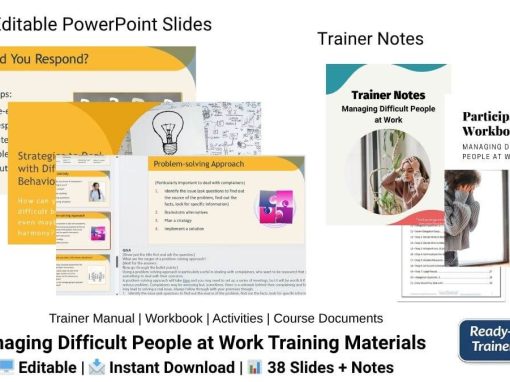
- Fully editable PowerPoint slides
- Trainer notes and participant guide
- Printable participant workbooks, handouts, and activities
If you are looking for more exercises to use in workplace workshops, please take a look at our other free soft skills training activities.