
Trust is not something employees automatically give because it is something you must earn as a manager. Managers who communicate honestly and effectively, listen carefully, keep to their promises, and show recognition where it’s due are better at creating trust from their team.
If you’re looking for ways to strengthen trust at work, these 12 tips are a good place to start.

Why Is Trust Important in the Workplace?
Before giving you seven useful tips for building trust, let’s just look at why trust in the workplace is so important!
Trust is essential for a number of reasons, including that it:
- Creates a sense of psychological safety in the workplace – meaning that staff feel comfortable to open up and to be involved. Staff who feel trusted are more likely to try new things and to get involved more
- Helps to create an atmosphere where employees are happier and enjoy going to work, and therefore are more productive
- Enables staff to feel more empowered because they feel valued in the company
- Makes employees feel more connected to the team, and this aids motivation.
It is worth remembering also that, in addition to trust between colleagues, it is also important to build trust with your clients or customers (especially so with healthcare organizations and when working in the medical field).
Building trust is one of the foundations of a positive workplace culture and helps employees feel valued and respected.
Tips for Building Trust in the Workplace
1. Learn to Listen
One of the simplest ways to build trust with your team and colleagues is just learning how to listen to other people.
‘Listening skills’ are vital in the workplace, and yet so many of us lack key skills in this area, and so we miss a great opportunity to better understand colleagues and staff we manage.
We all know how to listen on a superficial level, but how many of us really listen (rather than being more concerned with what we next want to say)? How often do we fail to really listen, and therefore we miss out on vital details?

Why do listening skills help with trust? It is because they:
- Help deepen relationships – Active listening helps you focus on a person and find out things about them that you would not have known otherwise. The more you listen, the deeper your relationships will be. Also, the other person will open up to you more, and they will be more likely to trust you and be your friends, rather than just acquaintances.
- Encourages collaboration – If you listen better to other people, you will be able to develop better collaborations. For example, at work, you and your colleagues will be able to listen to each other and learn about each other’s ideas and develop possible projects.
- Increases productivity – When people listen to each other, this decreases the risk of miscommunication, which is often one of the major causes of delays (as errors caused by miscommunication need to be rectified).
- Increases empathy – Empathy refers to the ability to understand another person and share their feelings. If you put yourself in someone else’s shoes, this helps you understand where other people are coming from.
- Helps you understand what motivates people – By listening to people effectively, you will understand what makes them tick. So, you will be able to motivate them. This is a good skill to have if you are a manager, for example, or if you are dealing with customers or negotiating with someone.
- Reduces the frequency of conflicts and helps find win-win solutions – When two people listen to each other, they are more likely to understand each other’s motivations and to empathize. As a result, they are more likely to either not start a conflict or, if they do, they will be more likely to find a win-win solution to the conflict.
You might find these resources useful on Listening Skills:
2. Learn to Show Empathy
Showing empathy can be important as it shows those we manage that we have compassion and understanding for their situation and that we care about them.
One good way to help managers and employees develop empathy is by providing Psychological Safety training.
Psychological safety in the workplace refers to a team climate in which staff feel comfortable to express their opinions, admit mistakes, give and receive feedback, suggest improvements and point out problems without fear of embarrassment, punishment or rejection by the rest of the team.
From the Psychological Safety page.
If you can imagine your own workplace. If colleagues always feel unable to freely give input and to express their own opinions and are constantly worried about being embarrassed, will the atmosphere be good? Will staff have confidence?
Would trust exist between employees?

If you are interested in providing empathy training, these empathy training activities for the workplace that help teams connect and communicate more effectively might be useful for you.
3. Use the Right Body Language (Non-Verbal Communication)
Teaching managers about body language is a very underestimated skill set that is often forgotten when training is provided.
Yet body language is so important and is particularly so in respect to how trust is developed between managers and employees, and between colleagues.
Have you ever experienced or seen any of these situations occur, for example?
- A team leader who fails to make contact with colleagues when giving a presentation?
- A manager who slouches a lot and gives the impression that s/he lacks motivation (the very person who is meant to be motivating you)?
- A colleague who stares too much as they listen to you, to the point that you feel uncomfortable and awkward?
- The manager who, without thinking, always leans over you too much when talking to you at your computer?
Increasing awareness of body language, its effects, and the right and wrong techniques is certainly a good idea if you are looking to build workplace trust between employees.

4. Lead by Example
The idea of leading by example is certainly not a new idea, and it might also seem quite an obvious thing to want to do as a team leader, manager, or anyone in charge of others at work.
It is surprising, though, as with many aspects of management, how leading by example is not used.
In a way, the lack of training in this area is understandable in that many managers rise through the ranks and often have not been given the training needed for first-time managers.
For trust, leading by example is essential because it means showing others that you care, are positive, work hard, and are not just pushing work onto others unfairly.
This is also one of the key traits of ethical leadership, as employees are more likely to trust managers who act fairly, are honest, and take responsibility for their decisions.
The team dynamics and etiquette in work teams are most often created by the manager (although also influenced by higher management and the HR department).
The first way to start building trust in the workplace by leading is to make sure that managers (especially first-time managers) are trained in core skills for people management.
5. Creating an Emotionally Intelligent Work Environment
The term ‘Emotional Intelligence’ is one that you may have heard in relation to workplace training, and it’s a topic that is especially important in building the trust we want to create at work.
If you want employees to feel a part of the team and to feel happy in their work, emotional intelligence is important.
What we are ideally looking for, in a good work environment, is a place where each employee:
- feels that they can comfortably be open and speak up when they feel the need to, i.e., they feel at ease to be assertive
- is motivated, is cooperative, supportive, and has a good working relationship with their colleagues
- feels able to take responsibility for their own actions and to own up to mistakes without fear
- can take and give feedback effectively
6. Take Onboarding (Induction) Seriously
It is surprising how one bad employee can affect a whole team and the whole dynamics within an office.
One thing you can certainly do is to try and help new staff integrate is to offer decent induction training, also known as onboarding.
Whilst it does incur costs in terms of time and money, onboarding is essential.
New employees need to feel that they are valued and a part of the company and that they have had the right on-the-job training and access to the right people.
If you want to build workplace trust, give new employees a good start, including:
- a mentor or someone they can turn to in the first month if they need any help
- the correct training for their specific role
- an introduction to everyone in their team and to key people they’ll be working with
- a point of contact for HR and for any services they need, i.e., IT (try not to leave a new employee stuck for three days with a computer login issue as happened to me in an old job).
7. Communicate With Colleagues
Whilst you clearly cannot provide all information to colleagues all the time, such as if the information is meant only for management, you can try to be as transparent as possible.
Be conscious of keeping your staff up-to-date as much as you can, both on minor and major things that might be of interest to them.
One of the easiest ways as a manager is to have weekly or bi-weekly meetings, even if you do it as a virtual online meeting because you have staff in different locations.
Being kept up-to-date and informed helps to breed positive trust!
This concept of sharing also applies to you if you are an employee at any level. Do not hold onto information because you are worried you will be less valued at work. Don’t hoard information.
8. Ask for Feedback
Being open to feedback, taking on board what your team members say, and being seen to care about what they have to say is a great way to build employee engagement. When employees feel valued and listened to, you will find that they buy into the work and team.
Likewise, invite feedback from clients and be seen to care and be open to change, which builds trust and mutually benefits you both.
9. Create an Inclusive Culture
One of the most important tips for building trust is to ensure that you create an inclusive workplace.
An inclusive workplace is one where all employees feel valued, have an equal opportunity, and are included the same as everyone else, no matter what their background, dis/ability, etc.
When employees feel that they are treated with respect, trust will follow!
10. Show Gratitude
Gratitude is such an easy thing to give, and yet it is amazing how many supervisors and managers fail to provide it.
Simply saying ‘thank you’ or ‘great job’ can often be enough to fulfill the needs of most employees. Most of us just want some gratitude, even if on a very basic level.
When employees regularly feel overlooked or undervalued, it can gradually damage workplace trust. Learn more about the Recognition Gap in the Workplace and how managers can prevent it.
Likewise, as a manager, you can easily use team meetings to thank your team and to show gratitude where it is earned. Just ensure, though, that when you show gratitude, you are sincere.
Looking for practical ideas? These Gratitude at Work examples show simple ways managers can make appreciation part of everyday workplace culture.
11. Admit Your Mistakes
We all make mistakes, and there is little we can do to change this. The bigger problem sometimes can come from trying to cover our mistakes and then getting caught out and losing trust with those around us at work.
Admitting to your mistakes can (as long as the mistakes are not too regular) be seen as a source of strength as a leader, as it can also send the message that employees can be creative and try new things, without the fear of failure, but they should own their mistakes and learn from them.
12. Provide Trust Building Activities
If you are a manager, a Human Resources department, or a college lecturer, one way to help teach trust-building is by using easy-to-run and fun activities that help teach trust.
I have developed a list of 15 of what I think are the best trust-building activities, exercises, and games that you can use, and you can find these trust activities here.
You can easily integrate one or two of these activities into team meetings, and most of them also work well for virtual meetings.
For more guides on improving engagement, motivation and workplace culture, visit our Employee Experience & Engagement Management hub.
How to Start Building Trust at Work
Having read these tips for building trust, you might now wonder how you can start teaching and implementing trust-building as part of your work.
If you are looking to do something to start working to build trust between employees, it can be worth providing a short workshop on workplace trust.
To provide this training, we have created the Trust Building teaching and training course materials, and these are instantly downloadable and include the PowerPoint slides, trainer notes, lesson plans, and suggested reading list. Basically, all you need is to provide Trust Building workshops to managers, employees, and, as needed, to business owners.
Building trust starts with acknowledging and addressing team tensions. Learn more about managing negative office dynamics in your workplace.
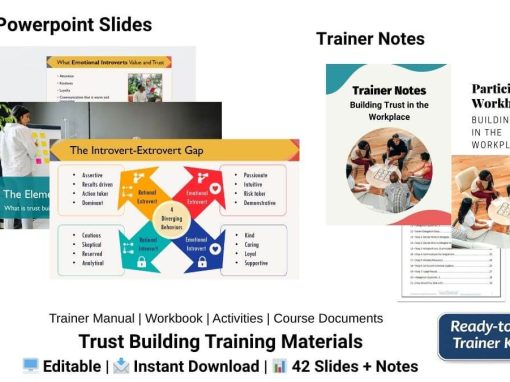
See the Ready-to-Use Training Materials
- Fully editable PowerPoint slides
- Trainer Notes & participants guide
- Printable participant workbooks, handouts & activities inthe PPTs


