Looking for a SWOT analysis activity to use in training? This exercise helps participants explore their strengths, weaknesses, opportunities, and threats while planning realistic personal or workplace goals.
In this SWOT analysis activity, participants will:
- Help participants plan SMARTER goals
- Understand Strengths, Weaknesses, Opportunities, and Threats
- Use SWOT as a self-assessment tool for personal or professional goals
- Improve goal setting
- Encourage discussion and reflection

In theory, you should be able to achieve any dream you want. But alas, in practice, it does not work like that.
Some dreams may not be achievable at all. For example, to become the first dancer of the Bolshoi Ballet (one of the most important ballet companies in the world) is not achievable if you, for example, are in your forties and have never danced in your life.
You are still free to dream, of course, but your dream is unlikely to become a reality.
Unlike dreams, goals need to be achievable, and there is a tool that can help you analyze your chances of achieving a goal and how to maximize these chances.
This is the SWOT analysis, a decision-making and strategic planning tool from the world of business that can also be very useful in your personal life.
Activity Time
10 to 15 minutes is a perfect amount of time for this activity.
At first, start this activity by only showing the title and the diagram, but without words, to your participants.

Has anyone heard of SWOT analysis? What does SWOT stand for?
Wait for their answers. Then show the titles of each list.
SWOT stands for:
- Strengths
- Weaknesses
- Opportunities
- Threats
SWOT Analysis Activity Q&A
What Are Strengths in a SWOT Analysis?
Strengths are the personal qualities, skills, knowledge, and resources that help someone achieve a goal.
Ask the group: “What are the strengths in a SWOT analysis?”
Wait for their answers and allow some time for class discussion around this question.
Then click to reveal the first list.

These can be:
- The abilities and skills you have
- Previous experiences that can be useful for achieving your goal
- Your knowledge of the topic and any other resources such as money, technologies, instruments, the time you already have.
What Are Weaknesses in SWOT Analysis?
Weaknesses are the skills, resources, or limitations that could make achieving a goal more difficult.
What are the weaknesses?
Wait for their answers and then click to reveal the second list.

Weaknesses are the opposite of strengths, such as things or skills you lack, contacts you need to make, or other limitations. Listing your weaknesses is not meant to discourage you.
On the contrary, you list what you are lacking so that you can plan how to acquire those skills or things that you need to achieve your goal.
Click to reveal the writing at the top.
Strengths and weaknesses are down to you. They relate to what you, as an individual, either have or need to get.
What Are the Opportunities in SWOT Analysis?
Opportunities are external situations or developments that could help someone achieve their goal if they recognize and make use of them.
What are opportunities?
Wait for their answers and then click to reveal the third list.

Opportunities are situations in the environment around you that can be positive for achieving your goal. You can identify, grab, or create opportunities.
For example, an opportunity can be a positive trend; support that is available for you to access; networking channels to tap into; available training, or new technologies that are being developed that could help you.
What Are Threats in SWOT Analysis?
Threats are external obstacles, risks, or changes that could prevent someone from achieving their goal.
Ask the participants ‘What are threats?’.
Wait for their answers and then click to reveal the fourth list.

Threats are things that can be an obstacle to you in achieving your goal.
The idea is that you identify threats so you can find ways to overcome them. If threats cannot be overcome, can you at least prepare to minimize their impact?
Threats can be any type of obstacle, including risks to do, for example, with a change in the state of the economy (this can also be an opportunity, depending on the situation) or sudden changes in your circumstances.
Opportunities and threats are down to other people and to the environment around you. They are not under your control but you can plan to make the most of them or deal with them.
If They Have a Workbook
Explain to your participants that now they need to put into practice the SWOT analysis for their SMARTER goal, which they might have set in a previous activity if you are teaching the concept of SMARTER goals in the same session.
They will find a SWOT analysis template to use in their workbook.
For this SWOT analysis activity, participants can start working alone and then discuss in pairs. Alternatively, they can start working in pairs straight away, as bouncing ideas off each other might help them with the exercise.
Allow 5 to 10 minutes for the activity and then another 5 minutes to share their thoughts with the class as a whole.
If you’re running a longer personal development workshop, participants may also benefit from our Life Planning Mission Statement activity, which helps them clarify their long-term values and direction before developing detailed action plans.
Looking for more free workshop exercises? Browse our collection of Soft Skills Training Exercises and Activities.
If You Are Teaching Online
Allocate participants in virtual breakout rooms for working in pairs.
They can use the chat facility or a virtual whiteboard if they want to write down and share notes in real-time.
At the end of the pair discussion, bring all participants back together to the main room for a final summary of the activity.
Teaching Life Planning & Goal Setting
If you are interested in providing teaching or training on goal setting and/or life planning and coaching, the materials below might be of interest to you. Just click on the banner to learn more.
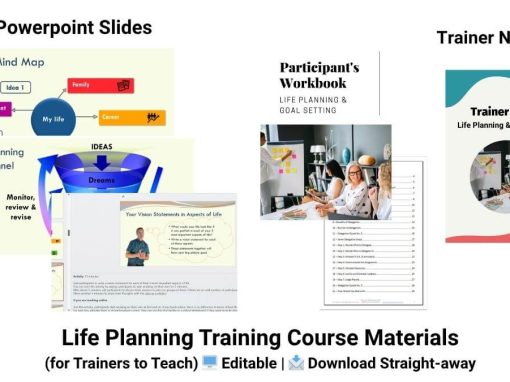
Need Complete Life Planning & Goal Setting Training Materials?
If you’re running a longer workshop, our editable Life Planning & Goal Setting Training Materials provide everything you need to deliver an engaging trainer-led session—saving hours of preparation.
- Fully editable PowerPoint slides
- Trainer notes and participant guide
- Participant workbook, handouts, and practical training activities included