
Collaboration is an important skill in the workplace, and if you are teaching or providing training to students or employees, you might want to use these 12 collaboration activities, exercises, and games. These are also great team-building activities for students if you are a professor or lecturer teaching business students.

What Are Collaboration Activities?
Collaboration activities are games and exercises that you can use in workshops, classes, seminars, and meetings for employees, students, or anyone doing adult learning.
These activities are aimed at teaching participants how to work together effectively and efficiently so that they feel engaged and enjoy the process.
Collaboration activities are commonly used in the workplace (for training) and in classrooms, i.e., for teaching university or college students.
The main purpose of using collaboration activities is to create a unified approach to working together with others and to ensure a shared sense of purpose.
What are some good activities to boost team collaboration?
To encourage better teamwork, try using icebreakers for team bonding, group problem-solving tasks to develop critical thinking, role-play scenarios for practising communication, and decision-making challenges. These hands-on activities help team members get comfortable with one another, improve communication, and learn how to work together effectively.
Benefits of Using Collaboration Activities
Collaboration activities, in essence, make learning more fun and break the training down for training facilitators into more manageable stages.
The activities also help participants with:
- Teamwork – Learn how to work well as a team
- Communication – Develop communication skills, including feedback and listening skills.
- Engagement – To engage with each other, which, in turn, benefits employee well-being and engagement.
- Problem Solving – Learn problem-solving skills and creative thinking in the workplace.
Why Is Collaboration Important?
Whether we work alone or as part of a team, we inevitably need to work with others and collaborate.
If you are a web designer working for yourself, you will still need to deal with clients. If you work for a company, then there are managers, colleagues, and clients to work with.
Collaboration is vital in business because our ability to work well with others can define how successful or not we are.
The issue is that we all have different personalities, ways of working, and our own ideas of how best to do certain things, and these ways often conflict with colleagues, clients, and our own team.
Collaboration skills, though, can be learned, and they can be taught.
Collaboration Activities and Exercises
The following activities can be used in your training, whether it is to teach collaboration skills or related to other training, such as communication skills training. Enjoy!
1. Tower of Cups: A Team-Building Challenge
Number of Participants: 5 per group is ideal, but adapt as needed.
Time Needed: 20 minutes.
Intention: This tends to be one of the most enjoyable collaboration activities for participants, and it is great for getting participants to develop their problem-solving skills and to use creatively as a team.
Items needed: There are a couple of items you will need to provide as the trainer or teacher, and these are:
- Plastic or paper cups (I suggest 18 per team)
- Elastic bands (rubber bands) 1 per team
- Piece of string – 6 pieces per team, with each piece approx. 2 feet long.
How to Run the Activity: To get this activity started, divide the participants into teams of 5 and then provide each team with an elastic band, pieces of string, and paper or plastic cups.
Now explain to the participants that they will use the elastic band and string in whatever way they can think of, to pick up the cups and then stack them.
The idea will be to build a tower as high as they can with the cups, but they have to do so using the elastic band and string, i.e., their hands are NOT allowed to touch the cups.
In fact, no part of their body must touch the cups. If it does, they must knock down the tower and start again.
It is up to the participants in each team to work out how to build this tower with the tools provided, so some innovation and thought will be needed.
Give the teams 15 minutes to build their tower.
After the 15 minutes are up, you might want to then have a quick 5-minute class discussion about the strategies they used and anything they learned.
2. Spider Web
Number of Participants: 6 or more participants.
Time Needed: 30 minutes.
Intention: This collaboration exercise is a great icebreaker that also requires teamwork and strategic thinking skills
Items Needed: This exercise also requires some materials, and these are as follows:
- Ropes or balls of string
- Two poles or walls to tie the ropes between (or use a large, sturdy frame)
- Masking tape (optional)
How to Run the Activity: This admittedly does require a little bit of setup time on your part as the training coordinator, so if you are looking for quick 5 or 10-minute activities, we have another post on those, or you can use the other activities in this post.
To set this up, you need to create the spider web, and this will involve you tying ropes or string between two poles, or other props such as trees or walls.
You need to leave various-sized gaps between the string/rope, and these spaces are ones that participants will aim to navigate through, but without touching the string/rope.
So you will need to create a web that has gaps just about large enough for people to fit through.
The web should also be off the ground but not too high, such that it creates a safety risk.
To start the activity itself, explain to the participants that:
- Everyone in their team must pass through the web without touching the rope/string.
- The whole team must start again if someone touches the rope/string.
- The team must use more than one route through the web to be successful.
Give participants 20 minutes to try to complete the activity as a team.
Generally, you will hear a lot of laughter as this is a lot of fun for those who take part.
After 20 minutes, have a group discussion about the strategy and thinking they used to try to navigate the web.
You might wish to end the activity by explaining that the best way to succeed in this type of team activity is through collaboration and learning to work effectively as a team.
3. Consensus Decision-Making
Number of Participants: 5 or more participants.
Time Needed: 30 minutes.
Intention: This activity works well as a decision-making activity or for teaching collaboration skills, as it requires participants to listen to consider perspectives, and then, as a team, they must discuss and then agree on a final decision.
Items Needed: Before the activity, you will need to prepare some scenario cards with situations listed on them that will require a decision.
To give one example of a scenario:
| Flexible Working Hours Idea The Company: Bob’s Holidays is a company planning to start offering remote working as an option for its travel consultants. They are also considering offering flexible hours, provided they have a skeleton staff always available in person for UK office hours. Bob and his wife Jane (the two founders) want to make sure that the policies meet the needs of all employees. Consensus Process: Bob and Jane ask their senior manager to develop a small committee of employees from various departments so that they can meet to discuss the proposed policies. The committee will gather input from their colleagues, and they will discuss potential impacts (and benefits), and give feedback on whether these policies should or should not be introduced and what the pros, cons, and other considerations and issues might be. Whether to offer flexible hours should be introduced, and whether remote working should be allowed must be decided by you, the committee. Notes: i) The agency is a UK-based agency, and most of their customers expect them to be open from 9 to 5, Monday to Friday. ii) Many customers are elderly customers who seem to enjoy the in-person element of the business. |
How to Run the Activity: Start by explaining to participants that as a team, they must agree on a decision, and EVERYONE must agree on one outcome. They must agree 100% on the final choice, even if it means compromising.
Hand the participants a scenario and ask them as a team to discuss the scenario, share their views, suggest possible priorities, discuss all factors, and make a final decision.
The participants in each team will likely have different perspectives, so they must negotiate in order to reach an agreement.
4. The Communication Maze
Number of Participants: 6 or more ideally.
Time Needed: 30 minutes.
Intention: A great activity for collaboration, especially where you are also emphasizing trust in the workplace, although this is another one of the collaboration skills activities that does require a little bit more set-up as a training facilitator.
Materials Needed:
- A large open space
- Objects such as some chairs or ropes to create a simple maze
- Blindfolds (one per team)
How to run the activity: The maze you design will need to have a starting point and a clear endpoint. It can be worth setting this up before the participants arrive so that you can do this activity early on in the sessions and then clear the room.
I would recommend starting the activity by explaining the activity rules, as these are as follows:
One participant will be blindfolded when the activity starts, and the idea is that they will walk through the maze, and do so with their team using verbal cues to guide them.
What is required in this activity is excellent communication and excellent teamwork (you can’t afford to be talking over each other), and the person walking the maze will need to focus on listening skills.
One key rule is that if the blindfolded person walks into an obstacle, then they must start again.
You can give a few participants a chance, if they wish, to be the blindfolded person navigating the maze.
You can make the maze slightly different if you are teaching a group with excellent communication skills.
5. Paper Plane Contest
Number of Participants: Ideally, 6 or more, so that you can at least have two teams.
Time Needed: 20 minutes.
Intention: This is a useful collaboration teaching activity for helping participants think creatively and work together using teamwork and problem-solving skills.
Items Needed:
- Several sheets of paper
- Various items for participants to use, such as some tape, paper clips, etc.
- Tape measuring (to measure the distance)
How to Run the Activity: Begin this activity by providing the participants with the materials they need (the easiest way is to place everything on a desk and ask them to come up and grab some sheets of paper, and then some of the other items on the desk).
You can explain to the participants that the aim of this collaborative activity is to make a paper airplane that flies further than the other teams’ planes.
Anyone can make a paper airplane, but can you make the one that flies furthest and is better designed and built than your colleagues’?
Split everyone into teams of 4 or 5 and then give them 15 minutes to design and make their airplane as a team.
They are allowed only 5 test flights during the 15 minutes, so they must use their 5 chances wisely (this adds another fun dimension to the exercise).
After 15 minutes, each team will have one chance to throw their plane and see how far it lands. The distance is then measured, and a winner is chosen.
I like to end the activity with a 5-minute discussion to chat with the participants about how they collaborated and how they worked together, i.e., any strategies, lessons learned, and so on.
6. Silent Team Building
Time Needed: 60 minutes.
Number of People Needed: 10 or more, ideally.
Intention: The Silent Team Building activity benefits those taking part through teaching non-verbal communication and teamwork skills.
The particular version of this that I enjoy teaching is non-verbal storytelling.
Split people into teams and give them a story they must act out using only gestures, expressions, and body language.
Give the teams of 5 to 6 people a handout explaining their scenario (such as you are going to a concert but cannot find your ticket, and eventually find it, but then once inside, you cannot find any money for refreshments, so you go without, and then you watch the concert).
You can probably come up with some better scenarios, but this is one example.
Now, give the first group 5 minutes to read their scenario and to create a plan for acting out their scenario.
Then give each team 5 minutes to act out their story.
At the end of each act, the others in the class must try to say what the story was about.
7. Improv Olympics
Time Needed: 60 minutes.
Number of participants: 12 or more, ideally so you can build 2 or 3 teams to compete against each other.
Intention: Teammates will have to work together, be both creative and quick-thinking and act as a team.
How to Run the Activity: Divide participants into teams of 5 or 6 and have them perform different improvisation games, such as:
- Yes, And…: Teams build on each other’s statements starting with “Yes, and…” to create a story.
- Scene From a Hat: Teams draw random scene suggestions from a hat and perform short skits.
- Props: Teams are given random props and must create a scene incorporating them creatively.
- One-Word Story: Teams develop a story together by all adding one word at a time (see full instructions for one-word story).
- Party Quirks: One team member hosts a party, and the others arrive with assigned quirks or characters that the host must identify.
The participants themselves will vote on the winner of each activity.
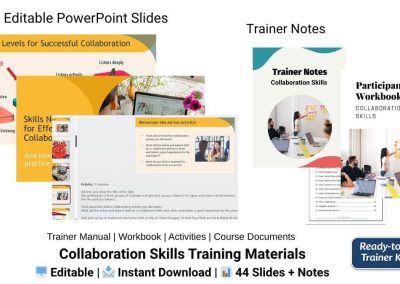
Need Collaboration Skills Training Materials?
Save hours in preparation time with our complete Collaboration Skills Training Materials — ideal for trainers, HR professionals, and facilitators.
8. Escape Room
Time Needed: 60 to 90 minutes.
Number of People Needed: Generally, 6 or more works well. Rent out more than one escape room as needed.
Intention: To work on collaboration skills through building teamwork and critical thinking under pressure.
How to Run the Activity: For this activity, I would book an established Escape Room venue (unless you feel like creating your own custom escape-style room in the office through different puzzles and clues).
If your HR department allows a budget for training, then you might want to enquire about getting the costs of the escape room covered as training costs.
In truth, the escape room experience is fantastic for employee bonding; it gives them a great chance to work together under stress (while also having fun), and overall, it is great for employee engagement.
If you are new to the Escape Rooms concept, it involves teams being locked in a room, and in the room are different puzzles that need to be solved in order for the team to escape.
The rooms are managed by the event organizers, so they are fun, safe, and very popular.
9. Team Mural
Time Needed: 60 minutes.
Number of participants: 8 or more.
Intention: I like this activity as it is a pretty relaxing one, but it nonetheless does help promote the need for collaboration and to think creatively. This can also be run as an outdoor team-building activity if you wish and if the weather permits.
How to Run the Activity: As the trainer or teacher, you will need to prepare and have available a large canvas or board on which the participants can draw and paint, etc.
You’ll also need to provide various art supplies such as brushes, paints, crayons, glue, etc.
As a team, the participants will have 60 minutes to create a piece of art, based on a theme of their choice (as the trainer).
If the participants are from a certain industry, then you might wish to tailor the art piece toward this industry.
10. Mascot Challenge
Time Needed: 30 minutes.
Number of Participants: Any number.
How to Run the Activity: This is another very creative activity and one that you will need to prepare some materials for, i.e., items suitable for arts and crafts, including markers, cardboard, paper, scissors, and glue.
Divide the participants into teams of three to five and explain to them that they need to:
- Agree on a team name
- Design a mascot that represents their team, and
- Come up with a positive slogan for their team.
They need to collaborate and try to build a narrative and story around the three things above, and then do a one-minute presentation at the end to the rest of the class.
They will explain their team name, the idea behind the design of their mascot, and its meaning, and their positive team slogan and the meaning behind that.
Although it’s a fairly simple activity to run, it can be fun, creative, and great for getting participants to work together and bond.
11. Geocaching
Time Needed: 30 minutes.
Number of participants: Any number.
Intention: This is one of those fun team-building games that involves teamwork.
How to Run the Activity: This activity does require a fair bit more planning on your part as the teacher or trainer, hence why I have left this activity towards the end of the list. I’ll let you decide if it’s too hard work on your part!
To run this activity, you will have to set up the “caches” beforehand (the caches, by the way, will be small containers with small items or notes in them), and then you’ll place them in different locations.
If you are a large business with a very large building, this can work well as you’ll have plenty of locations to place the caches.
As you place these items, note and write down the GPS coordinates for each cache.
Now, divide the participants into small teams and give them a printout of the coordinates for the caches.
They can now use one of their smartphones to navigate and find the Geocaches.
The team that finds the most caches in a given time wins.
12. Debate Club
Time Needed: 45 minutes.
Number of participants: +8.
Intention: The participants will work in debating teams to construct a clear and persuasive argument. This will involve the need to collaborate and work well together as a team. This is one of the best collaboration skills exercises for critical thinking.
How to Run the Activity: Ahead of the teaching/training session, you will need to decide what the class will debate, and I suggest shaping the debate around the particular industry or type of business that you are training.
If you are providing training to people in the marketing industry, for example, you might want to have them debate something marketing-related, such as ‘Influencer Marketing’.
If you only have two teams, you might want to have one team defend the use of Influencer marketing and one team take the opposite view.
Now, split participants into teams of 5 (but adjust this according to the class size) and give the participants 15 minutes to work as a team to discuss and write down the key points they will debate for/against the topic (their argument), and for the teams to work out who will argue each point. Everyone should be involved.
Then allow 20 minutes for the debate, and then 10 minutes afterwards for a general class discussion about how the debate went.
How Can I Teach Collaboration Skills?
Hopefully, these collaboration training activities have been useful for you. Below, you might also be interested in the Collaboration Skill teaching materials.


