
Symonds’ 8 Decision-Making Distractions Model is a workplace decision-making framework that identifies eight common cognitive, emotional, and situational factors that distract people from making objective, well-reasoned decisions—especially in professional and organizational settings.

For quick reference, the eight distractions are summarized below.
The 8 Decision-Making Distractions (Quick Summary)
- Personal wants & needs
- Information & options overload
- Internal interference (workplace pressures)
- External influences
- Lack of interest or focus
- Available resources (time, money, data)
- Perception & understanding (biases)
- Emotions
If you want to teach this model in workshops, team training, or leadership programs, our decision-making training materials provide ready-to-use slides, activities, and facilitator guidance that can be easily adapted to incorporate the Symonds’ 8 Decision-Making Distractions framework. These materials are designed for HR professionals, L&D teams, and professional trainers delivering in-house workshops.
What Are Common Decision-Making Distractions?
Common decision-making distractions include information overload, personal biases, and external pressures. Recognizing these factors and then acting on them is essential as a leader if you wish to make informed, objective decisions and to develop a focused decision-making environment.
What Are the 8 Decision-Making Distractions in the Symonds Model?
The Symonds model identifies eight core distractions that commonly influence workplace decision-making.
The eight distractions in the Symonds model are not necessarily new ideas. We already know, for example, that emotions, information overload, and pressure from other people can affect the decisions we make. What this model does is bring these different influences together and show how they can sometimes overlap, making decision-making even more complicated.
This model sits within a wider set of corporate training strategies used to design effective workplace learning and decision-making workshops.
Notes on the Model
- The distractions can often overlap, i.e., the emotions involved with internal pressures come under point 3, ‘Internal Interference’, but are also related to point 8 and emotions.
- The model is designed to raise awareness of the distractions and influences that impact our decision-making, particularly in the workplace. In training settings, this awareness is often developed through facilitated discussion, reflection, and scenario-based group exercises.
- I do not cover practical solutions such as root cause analysis tools for workplace decision-making in this roadmap; however, these structured approaches are explored in more detail elsewhere and are commonly used in decision-making training workshops.
- In workplace training settings, the model is commonly used to strengthen critical thinking skills, improve leadership judgment, and reduce decision fatigue caused by cognitive overload and competing pressures.
1. Personal Wants (and Needs): How Do Personal Wants and Needs Affect Workplace Decisions?
Personal wants and needs influence workplace decisions by subtly shifting priorities away from objective outcomes toward personal comfort, work–life balance, or individual gain.
Making a decision, such as in the workplace, might initially seem to be a decision that is made based on the work and tasks at hand.
Decision-making, though, is far more complex, and our own personal needs come into play and directly impact the choices made.
While choosing to do something in a way that might be great for the company and likely achieve the best results, is it in the personal interests of the decision-maker?
Imagine John is a manager in a marketing department, and he decides to decline the offer of promotion because he feels that the role would demand more of his time and that the role might be more stressful than he is willing to take on. Even though the promotion could benefit the company, John chooses to prioritize his work-life balance and spare time.
From the company’s perspective, the promotion might seem like an obvious choice for John. In other situations, the decision might be made for personal gain at the expense of the team.
2. Information & Options Overload: How Does Information Overload Disrupt Decision-Making?
Information and options overload disrupt decision-making by overwhelming cognitive capacity, making it harder to evaluate evidence objectively and increasing the likelihood of shortcuts or biased judgments.
When we have too much information to take in, it can become difficult to know what to focus on. We might then struggle to make a decision, despite us having all the information we need.
Professor Chris Argyris, who created the Ladder of Inference, posits that we also sometimes are selective in what information we choose to take notice of.
Indeed, with so much information available for some decisions, it perhaps seems inevitable that we might naturally sometimes choose the information that fits with our own natural beliefs and way of thinking.
We can also easily get distracted by irrelevant details and feel paralyzed by having too many options and choices.
3. Internal Interference: How Do Internal Workplace Pressures Influence Decisions?
Internal workplace pressures influence decisions by introducing expectations, competition, and interpersonal dynamics that can override careful analysis and long-term organizational interests.
In the decision-making distractions model, we must also navigate the internal interference from people who are directly involved or affected by the decision, particularly in workplace decision-making.
i) Colleagues and co-workers – refers to those who might gain from our decision-making. It might, for example, save them work if we decide to take on a task, or a good decision might benefit the team as a whole and be a very positive thing for all.
ii) Managers – who manage us and who might want us to make a quick decision, or who might want us to make a decision that projects them (the manager) in a good light.
iii) Internal competition – in some sectors of business, certain job roles are much sought after, and competition is high. This can distract from the normal decision-making process. Internal competition can affect decision-making in three main ways:
Emotional Bias and Tension
Job competition can often be the cause of additional stress, anxiety, and, at times, resentment between colleagues.
These heightened emotions are one of the decision-making distractions that can affect judgment and lead to decisions driven by fear or personal ambition rather than what is perhaps the best decision for the team or project you are working on.
For example, an employee might choose not to share certain information and withhold it from the decision-making, thus avoiding sharing it with their team, because they might feel that doing so will give useful information to a rival.
Focus on Personal Gain (Rather Than on Team Success)
When competing for a promotion or to receive recognition, an employee may choose to prioritize decisions that highlight their own achievements.
Reduced Risk-Taking
People in a competitive environment might avoid taking risks or trying innovative approaches for fear of failure, as mistakes could jeopardize their chances of advancement.
iv) There is also what I like to call the “internal expectation value” – and this further adds to the internal influence and resulting pressure that can make you rush, overthink, or alter decision-making to suit the expectations of others.
- Pressure to Conform – Trying to meet the expectations of one’s manager and colleagues can cause stress, and this can result in decisions made to satisfy and placate these expectations (whether real or perceived expectations), rather than carefully weighing up and considering all options.
- Fear of Judgment – Likewise, the fear of being judged by others can cause some decisions to be overthought. Good decisions need to be carefully considered, but overthinking and overanalyzing can be counterproductive. What is known as decision paralysis, where too much time is spent analyzing potential outcomes, can be the result, and opportunities might be missed, or a bad decision made.
4. External Influences: How Do External Factors Shape Workplace Decisions?
External influences shape workplace decisions by applying social, political, commercial, or cultural pressure that can steer choices away from what would otherwise be considered the most rational option.
One only has to read media reports to see stories of special interest groups and external influences when it comes to politics and big business.
Decision-making can certainly be impacted by social pressures and by outsiders who are trying to get you to push/sell their product/service, be it ethically or unethically.
These external influences include:
- Special interest groups looking to influence our choice, such as the offer of money to make a favorable decision for the payee.
- Family – We might make a decision because we know it is in the best interest of our family or for our family life, and not necessarily, for example, because it will be the best decision possible.
- Media and Public Opinion – There are many greater sensitivities these days regarding many topics, including gender and the environment, to give two examples. Many of us are influenced by these sensitivities, and we might make decisions accordingly, even if the decision might not be what we might otherwise sometimes have chosen.
5. Lack of Interest or Focus: Why Does Low Engagement Lead to Poor Decisions?
A lack of interest or focus leads to poor decisions by reducing motivation to analyze information thoroughly, increasing impulsivity, and encouraging superficial or rushed choices.
Many people make decisions because they have to, rather than because they want to, particularly in the workplace.
When we talk about distractions in decision-making, a lack of interest is a common one, and we’ve all been there.
For small and minor decisions, this is not generally going to be a problem, but for important decisions in the workplace, it is an issue. Some issues are:
Superficial Analysis
When we lack interest in the decision-making and its outcome, we are less likely to make the same effort to try to fully understand the problem and possible outcomes.
Impatience and Rushed Decisions
When we lack focus and interest, it is also easy to rush the decision-making process just to get it over with. Such impulse choices can lead to poor decision-making and can be a big issue when they involve an important decision.
More Open to Trivial Distractions
With a lack of focus during decision-making, we also leave ourselves more open to distractions by trivial things. Have you ever been working on something important and chosen instead to constantly check emails and reply to non-important emails, and moved away from your thought process regarding the decisions you need to make, resulting in rushed decision-making? Most of us will have experienced this.
- Emotional Detachment – a lack of interest can also lead us toward emotional disengagement from the decision being made. If we are not invested in the outcome, it is much harder to be motivated and to make a thoughtful decision.
6. Available Resources: How Do Time, Budget, and Data Constraints Affect Decisions?
Constraints on time, budget, or access to information affect decisions by limiting available options and encouraging short-term or compromised choices rather than well-informed, strategic ones.
In terms of decision-making distractions, resources can affect the outcome in a number of ways. The key resources are as follows:
i) Access to Information
It is, of course, hard to make the best possible decision when we lack access to the right information or data. Yet, this is often the case in many management decisions.
A lack of investment in data analytics tools, or a lack of market research budget, for example, can result in poorer decisions being made.
For example, imagine having to decide which employee to promote for a very important and key sales management role, but lacking access to key sales performance data, i.e., KPIs.
Making a decision without this data might mean relying on more biased information, leading to unfair or misinformed decisions that don’t in any way help us maintain a fair and inclusive workplace.
ii) Financial
On a personal level, such as for personal finances, available money certainly can direct our choices and options when it comes to decision-making.
In the workplace, the financial resources available also affect the range of options a decision-maker has (including the lack of information for decision-making as discussed in point one above).
If we know that the budget is tight, then we will inevitably be influenced to buy cheaper items than we might otherwise have chosen. Indeed, we might find ourselves cutting corners in order to placate the budgetary constraints.
The problem is that these financial constraints can lead us to prioritize short-term gains over long-term planning.
iii) Time
Time is one of the most common decision-making distractions and one that we are all affected by at times.
Being rushed into a decision can mean that we fail to make the best possible decision.
7. Perception (and Understanding): How Do Biases and Interpretation Distort Decision-Making?
Biases and subjective interpretation distort decision-making by filtering how information is perceived, remembered, and evaluated, often leading to overconfidence or selective reasoning.
Personal factors, including any biases we have (unintentionally or not), and any emotional attachments, can impact our choices.
These perception-based distortions are closely related to the ladder of inference for decision-making, which explains how people unconsciously move from observable data to assumptions, beliefs, and actions in the workplace.
i) Cognitive Biases
Our personal perceptions are often influenced by cognitive biases such as confirmation bias (where we seek to support our own pre-existing beliefs) or anchoring bias (where we sometimes over-focus on the first piece of information we have).
A classic example of these personal preferences and perceptions is when we are involved with a project that might be similar to one we did in the past, and that we previously failed at.
The intricacies and conditions of the new project might actually be quite different, but we still make decisions that mean a very conservative approach, because of our fear of failing again.
ii) Emotional Involvement
When we have a personal stake in a problem, our emotional reactions can cloud our judgment.
The attachment we might have (whether positive or negative) to a specific outcome can lead us to overemphasize certain factors and make emotionally driven decisions rather than choosing an outcome based on logic.
A common example is when someone is a manager and is responsible for initially hiring someone. That manager will then often feel that they have a vested interest in that employee doing well because it was their decision to hire that person in the first place. This can often lead to favoritism toward this person.
iii) Overconfidence
Personal perception can sometimes cause overconfidence, where you believe you understand the problem better than others, dismissing alternative perspectives or data.
Overconfidence can lead to some bad decisions; a classic situation is that we might skip doing some necessary research because we think we know better.
iv) Personal Experience and Bias
Our past experiences can also shape how we perceive problems, and we sometimes might rely too much on what worked before and not necessarily what is best for the future.
This reliance on past solutions can cause us to miss new, innovative solutions or fail to adapt to a changing environment.
8. Emotions: How Do Emotional States Influence Decision Outcomes?
Emotional states influence decision outcomes by affecting risk tolerance, attention, and judgment, sometimes causing reactions driven more by feeling than by objective evaluation.
Our emotions are closely aligned with our ability to make good decisions and can be one of the biggest distractions while making crucial decisions.
i) Fear and Anxiety
Fear or anxiety can lead us to imagine and consider potential negative outcomes, and such thinking can lead us toward making risk-averse decisions.
ii) Anger or Frustration
Negative emotions, such as anger, can also stop us from making good decisions, as such feelings can cloud our ability to think clearly.
We might also end up ignoring advice from others or ignoring important information.
iii) Guilt, Sadness, and Apathy
Guilt can lead us to make compensatory decisions to make up for past errors, as we attempt to correct the past (even though this is normally unnecessary).
Likewise, when we feel sad or apathetic, we can become disinterested in the decision-making process and make the wrong decision.
This lack of emotional energy can lead to procrastination or avoiding the problem altogether.
iv) Attachment to the Outcome
Emotions can cause us to become overly attached to specific outcomes that we’re invested in emotionally, rather than making decisions based on what’s objectively best.
This attachment can make it difficult to let go of ideas or goals that aren’t working, distracting from more rational or flexible decision-making.
v) Stress and Overwhelm
High levels of stress can reduce our ability to think clearly, leading to reactive or short-term decisions.
When overwhelmed, we may focus on immediate relief rather than long-term strategy, prioritizing decisions that reduce stress now but potentially create bigger problems later.
vi) Empathy and Sympathy
Emotional empathy is also one of the decision-making distractions that exist, as we focus too much on the emotional well-being of certain individuals rather than what’s best for the team or company.
When Is This Model Most Useful in Training?
This model can be useful in leadership and decision-making workshops, especially when you want people to think about what might be affecting the choices they make at work. It can also help start discussions about the different pressures and distractions we face when making decisions.
- When exploring how cognitive, emotional, and situational factors influence workplace decision-making.
- As a discussion framework in leadership development and management training programs.
- To support reflective learning in HR and L&D-led workshops focused on judgment and decision quality.
- When introducing decision-making concepts in higher education or professional development settings.
- As a precursor to applied tools and techniques used in structured decision-making training.
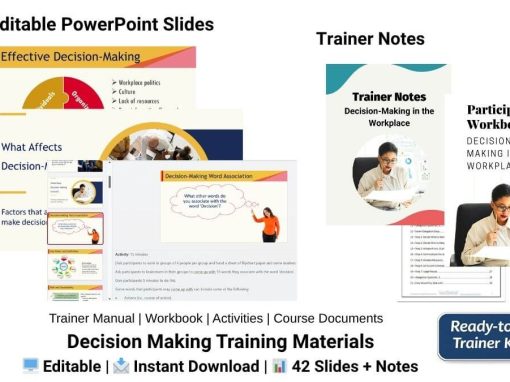
Teaching Decision-Making in the Workplace?
Our ready-to-use decision-making training materials help facilitators, HR teams, and L&D professionals deliver structured, practical workshops with minimal preparation time.


