
In this activity, we look at four types of workplace absence: legitimate and illegitimate, and planned and unplanned. Managers can then discuss examples of each type, the impact they can have at work, and how they might be managed.

This training activity covers:
- The four main types of workplace absence
- Legitimate vs illegitimate absence examples
- Planned vs unplanned absence scenarios
- A ready-to-use discussion and quadrant exercise for managers
Who Is This Absence Training Activity For?
- HR managers delivering absence management workshops
- L&D teams running in-house training
- Frontline managers needing practical tools
- Freelance trainers delivering workplace sessions
What Are the Effects of Absenteeism on a Business?
Absenteeism can increase costs, reduce productivity, and damage morale and customer satisfaction. Understanding these effects helps managers see why structured absence management is an HR best practice.
With the effects in mind, before starting the main activity, it is useful first to run through the ‘Effects of absenteeism in the workplace’ with the participants.
To do this, we can start with a Q&A (Questions and Answers) task.
At first, show only the title of the slide below (you can recreate the slide in PowerPoint). Before showing the points on the slide, though, ask participants the following question.
What are the effects of absenteeism on a company?
Wait for answers.
Trainer tip: Allow silence. Managers often need reflection time before identifying indirect absence costs.
After participants have answered, go through the points on the slide.

1. Increased costs
For example, these can include paying overtime for employees who cover absences, paying for temporary staff, and loss of productivity.
2. Decreased productivity
When employees are absent, other members of staff might have to cover for them, thus adding the absentee employee’s workload and responsibilities to their own.
This is likely to lead to an overall loss of productivity.
3. Demotivated employees
Staff members who have to cover for other members of staff who are absent might start to resent this, particularly if their extra efforts are not recognized.
This can lead to lower morale and demotivation.
Patterns of workplace absence are often early indicators of deeper issues in terms of engagement or workplace culture issues.
You can learn more about Employee Experience & Engagement Management guides, which include discussion on areas such as onboarding, recognition, feedback, and retention strategies – all of which influence attendance and morale.
4. Decreased customer satisfaction
For departments that deal with customers, more pressure on staff who cover for those who are absent might lead to lower customer satisfaction.
What Are the Main Types of Absence in the Workplace?
We can look at workplace absence in four main categories: legitimate vs illegitimate, and planned vs unplanned. In US HR policies, you may also come across related terms such as authorized and unauthorized absence. Each type needs to be managed slightly differently.
With this in mind, now to the main part of the training activity. At first, only show the title and the empty diagram on the slide in the picture below.
Before showing the content of each quadrant, say the following to the participants and then ask the questions that follow afterward.
“We have talked about the effects of absenteeism. However, not all absences are absenteeism, and not all absenteeism is the same.
Before categorizing absence types, though, it can also be useful to explore the top causes of absenteeism in the workplace, as these often reveal underlying cultural or management issues.
Think about any reasons why an employee might be absent from work, one example being for vacation leave. What are the different types of absence, and why might an employee be absent from work?
Secondly, also ask the participants to decide if that type of leave of absence from work might be legitimate or illegitimate, and planned or unplanned.
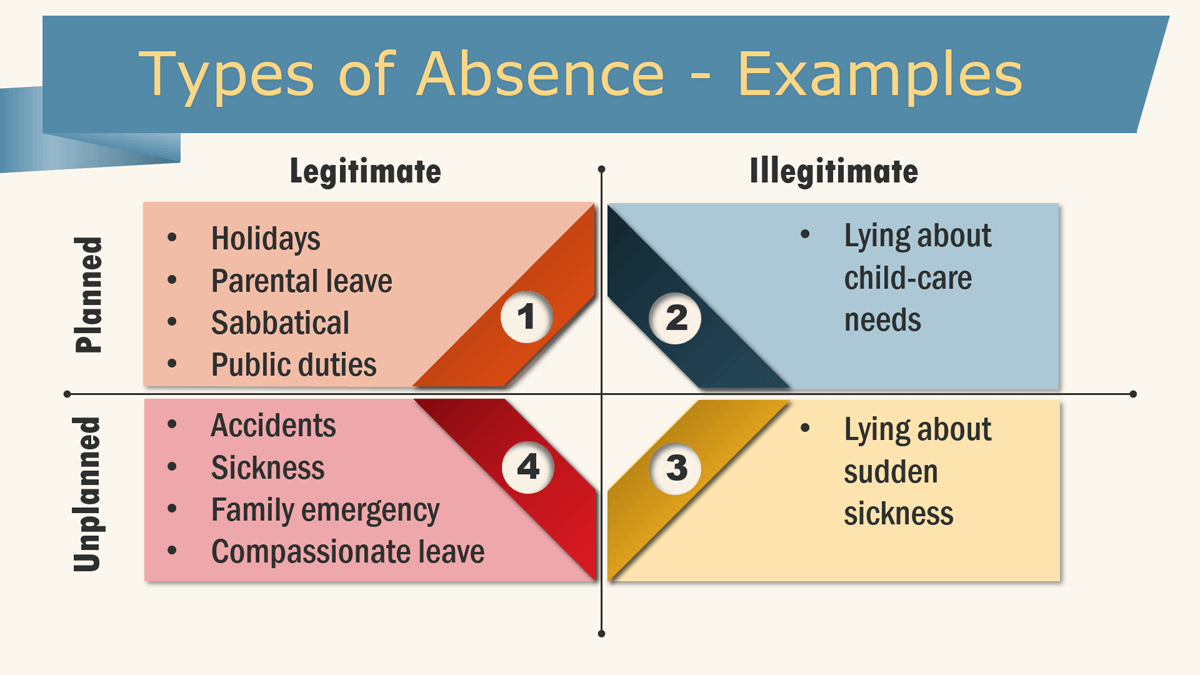
In other words, what types of absence in the workplace would they place in each quadrant of the diagram in the slide image below?

Wait for answers.
As participants answer, you might want to jot down their answers on a flipchart (or on a virtual whiteboard if you are teaching online).
Alternatively, you might want to run this Q&A as an activity, whereby participants are split into groups, and each group writes down their answers and then discusses them with the class as a whole.
After participants have answered, show them the rest of the content on the slide and explain.
What Is a Legitimate Workplace Absence?
A legitimate workplace absence is one where there is a genuine and acceptable reason for time away from work, such as sickness absence, vacation or paid time off (PTO), or compassionate leave.
In other words, ‘Legitimate’ means that there is a good reason for employees to be absent. For example, going on vacation (as everyone deserves a break), compassionate leave, etc.
What Is an Illegitimate Workplace Absence?
An illegitimate absence occurs when an employee takes time off without a valid reason or misuses discretionary absence provisions, often signaling deeper employee relations concerns.
The problem here is that illegitimate absences are often difficult to identify with certainty.
For example, we can think about somebody lying about being ill (but we can never be sure that they are lying unless we have some sort of proof, which is usually very hard to get).
Interestingly, companies struggling with high absence levels often also experience presenteeism. Understanding the main causes of presenteeism in the workplace helps managers address both behaviors effectively.
What Is the Difference Between Planned and Unplanned Absence?
Then, we can separate absences depending on whether they are planned (we know about these in advance) or unplanned (they are unforeseen), and each type can have a different impact on a company.
So, now we have four separate quadrants into which we can classify absences, and we will see that a company needs to look at each type differently.
Facilitator note: Ask managers which quadrant appears most frequently in their department and why.
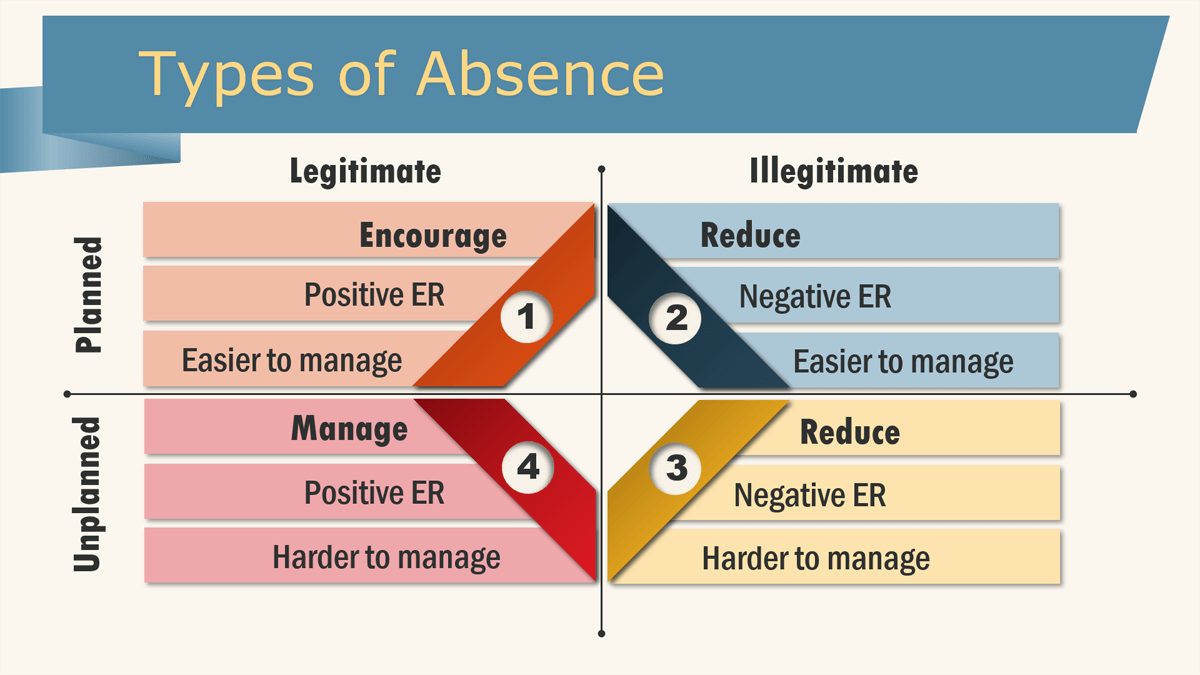
How Should the Four Types of Workplace Absence Be Managed?
NOTE: ER stands for ‘employee relations’, which defines the relationship between employers and employees.
Quadrant 1 – Legitimate and Planned Absence
Examples of this type of absence are vacations, parental leave, leave to care for a dependent, sabbatical, leave for medical appointments, disability leave, jury duty or other civic duties, etc.
This type of absence needs to be encouraged. Why?
First of all, encouraging this type of absence can lead to positive employee relations and strong alignment with absence management policy, which means a good relationship between an employer and their employees.
Providing your employees with decent vacation allowances and other types of leave as needed makes them feel appreciated, supported, and comfortable working for you.
Second, this type of absence is easier to manage for a company compared to other types of absence, as you can plan in advance and arrange cover with enough warning.
Quadrant 2 – Illegitimate and Planned Absence
Using types of legitimate leave, including misuse of discretionary absence when they are not necessary. This would involve the employee lying, but, as mentioned before, it is often hard to prove, so you need to be careful before making accusations.
This type of absence needs to be reduced.
The problem is that this type of absence can be a symptom of poor employee relations.
So, if you think that in your company there might be a high level of this type of absence, you might want to assess things such as your employees’ satisfaction level and find out what it is in your company’s culture that causes low satisfaction for employees.
When this type of absence is planned, it is generally easier to manage operationally, because you can find ways to provide cover in advance.
Quadrant 3 – Illegitimate and Unplanned Absence
The third quadrant contains the most disruptive type, illegitimate and unplanned. This is highly negative, and this is the one you want to reduce at all costs.
For example, this type of absence includes calling in sick when not actually ill.
Even in this case, it is very hard for an employer to prove that an employee is lying, so you should not make accusations.
If you think that this type of absence is frequent in your company, you need to worry, as it is a symptom of poor employee relations, and this is hard to manage (trying to find cover at the last minute, for example).
Use this question with managers: What patterns do you notice, and what might they indicate about morale or workload?
The good news is that you can reduce this type of absence by putting strategies in place to improve your ER.
Quadrant 4 – Legitimate and Unplanned Absence
The last type of absence is legitimate and unplanned. For example, this happens when an employee has an accident, gets sick (for example, sickness absence), needs compassionate leave, or needs to look after a dependent at short notice.
Unforeseen circumstances will always happen in people’s lives, so you need to manage this type of absence as best as you can and be supportive of your employees.
To a certain extent, you can try to reduce this type of absence by addressing health and safety at work and promoting healthy living among your employees. However, you can never eliminate it completely.
If you manage this type of absence correctly, with compassion and a supportive attitude, it can lead to a positive ER.
This type of absence is quite hard to manage as it is unplanned.
Companies can also strengthen their approach by implementing structured return-to-work interviews, which help identify patterns and underlying causes of absence.
In summary:
- Not all absence is negative or harmful to a business
- Planned, legitimate absence should be supported and encouraged
- Illegitimate and unplanned absence often signals employee relations issues
- Managers need different responses depending on the absence type

Ready-to-Run Absence Management Training Materials
- Fully editable PowerPoint slides
- Trainer notes with step-by-step facilitation guidance
- Participant workbooks, handouts, and practical activities included
Quick Facilitator Checklist Before You Run This Session
- Slides prepared and customized
- Examples adapted to your company
- Flipchart or virtual whiteboard ready
- Discussion timing planned
- Return-to-work and policy references prepared
If you would like a complete, ready-to-run absence management training session, including slides, trainer notes, and participant materials, you can explore the full Absence Management Training Kit below.
What’s Included in the Full Absence Management Training Kit?
- Editable PowerPoint slides
- Trainer notes with facilitation guidance
- Participant workbooks & handouts
- Ready-to-use activities and exercises
FAQs
Can I run an absence training session even if I am not HR trained?
Yes. The activity has been designed to be suitable for training facilitators and managers to use, with instructions, discussion prompts, and examples included so that you do not require an HR background.
Is this activity suitable for in-house and online training delivery?
Yes. The activity works well for classroom, virtual, and hybrid sessions, and you can easily adapt it for group discussions and to use in breakout rooms as needed.


