These communication role-play scenarios for workplace training are designed to help participants practice real workplace communication situations such as misunderstandings, unclear instructions, feedback conversations, email misunderstandings, and remote communication issues.

- What’s Included: 8 realistic workplace scenarios with instructions, debrief questions, and variations
- Best For: Communication skills training, leadership workshops, team development, and professional development sessions
- Typical Format: Pair or small-group role plays followed by structured discussion and replay
- Skills Practiced: Active listening, giving feedback, speaking up, tone awareness, and resolving misunderstandings
- Use Cases: Difficult conversations, unclear instructions, email tone issues, remote communication, and cross-team challenges
You can use these scenarios in communication skills training, leadership training, team building workshops, and professional development sessions.
Communication problems at work are often small on the surface, but costly in practice. A manager gives unclear instructions, an employee stays silent instead of raising a concern, a short email sounds rude, or a feedback conversation becomes defensive. In most workplaces, these situations happen every day.
Role play is a simple and effective communication training activity because it allows participants to practice real workplace conversations in a safe setting. Instead of only discussing communication skills in theory, participants can practice realistic conversations, notice what causes misunderstandings, and try more effective communication approaches.
This page includes 8 workplace communication role-play scenarios, instructions for trainers, debrief questions, variations, and an online version of the activity. These role-plays can be used in a wide range of workplace training courses where communication skills are important.
For more useful guides and resources such as workplace feedback, listening, assertiveness, and other communication topics, make sure to visit the workplace communication guides for managers, HR professionals, and trainers hub.
When Should You Use Communication Role-Play Scenarios in Training?
You can use communication role-play scenarios when delivering workplace training, whenever you think participants need to practice communication skills, rather than just discuss them.
You will find that scenarios are particularly useful when you introduce topics such as active listening, giving feedback, assertive communication, managing difficult conversations, or improving team communication. This is because doing role-play allows participants to practice these skills in realistic workplace situations.
These communication role-play scenarios can be used in:
- Communication skills training
- Leadership and management training
- Team building workshops
- Conflict management training
- Customer service training
- Professional development programs
- Remote team training
- Interpersonal skills training
Why Use Communication Role-Play Scenarios in Workplace Training?
People can usually understand the basics of good communication skills easily, in theory, but they may find it harder to apply them in practice.
For instance, most people would agree that they should listen well, speak clearly, and avoid making assumptions.
However, it is not always easy to do that in real conversations, especially when you are under pressure, short on time, or feeling emotional.
Communication role-play scenarios are useful because they allow participants to practice specific communication skills in realistic situations, rather than only talking about communication in theory.
These role-plays help participants practice:
- Listening and clarifying
- Noticing misunderstandings
- Choosing better wording and tone
- Giving feedback
- Speaking up professionally
- Handling difficult conversations
- Improving email and remote communication
- Adapting communication to different audiences
Because the scenarios are realistic, participants usually recognize the situations immediately, which makes the activity engaging and relevant to real work.
Role play is considered a form of experiential learning in that it helps participants practice communication behaviors rather than only discussing them in theory.
How Do You Run Communication Role-Play Scenarios in Workplace Training?
To run communication role-play scenarios in workplace training, divide participants into pairs or small groups, assign roles, run short role-plays, and follow with a structured debrief and discussion.
Simple process:
- Divide participants into pairs or groups of three.
- Give each group one scenario.
- Ask participants to decide who will play each role.
- Allow 2–3 minutes to read the scenario and prepare.
- Give 4–6 minutes for the role-play.
- If using an observer, ask them to note communication behaviors (listening, tone, assumptions, clarity).
- Debrief in small groups.
- Bring the whole group together for a wider discussion.
- If time allows, ask participants to replay the scenario using a more effective communication approach.
Suggested timing:
- Introduction: 5 minutes
- Preparation: 3 minutes
- Role play: 5 minutes
- Small group debrief: 5 minutes
- Whole group discussion: 10 minutes
Total: 25–30 minutes
What Are Some Communication Role-Play Scenarios for Workplace Training?
Communication role-play scenarios for workplace training include situations such as misunderstandings between colleagues, unclear instructions, feedback conversations, email tone issues, and remote communication challenges.
Below are 8 you can use in your workplace training sessions.
1. Misunderstanding Between Colleagues
Two colleagues are working on the same project. Everything goes well until they miscommunicate over timelines.
One colleague believes that the other person agreed to complete a certain task within one day. The other colleague, though, doesn’t agree and instead believes that they only agreed to review the task, not complete it.
Both colleagues are frustrated and feel that the other person is being unreasonable.
Task: Role-play a conversation to clarify what was agreed and decide next steps.
2. Manager Giving Unclear Instructions
A manager asks an employee to “put something together” for a client meeting, without giving further details.
So, the employee makes an assumption and prepares a short summary, but the manager expected a full presentation. Both feel frustrated.
Task: Role-play a conversation to clarify expectations and discuss how to communicate more clearly in the future.
3. Employee Not Speaking Up
During a team meeting, an employee notices a possible problem with a timeline but says nothing. Later, the issue causes delays.
The manager asks why nobody in the team raised the concern earlier.
Task: Role-play a conversation about why the employee did not speak up and how to improve communication in the future.
4. Giving Feedback Conversation
An employee keeps interrupting other people while they are speaking in meetings.
So, their manager decides to raise the issue with the employee, but they are hesitant because they are afraid that the employee may become defensive.
Task: Role-play a constructive feedback conversation that is clear but not confrontational.
5. Remote Communication Issue
A manager is leading a hybrid team, where only one employee works remotely, while the rest are based in the office.
Most of the decisions in that team are made during informal office conversations and later shared more widely in formal meetings. This creates a problem, though, as the remote employee feels excluded from the decision-making process.
So, the employee who works remotely decides to speak to their manager about it, but is concerned about sounding like they are complaining.
Task: Role-play the conversation between the remote employee and their manager, in which they discuss how to improve communication in a hybrid team so that everyone feels included.
6. Email Misunderstanding
An employee receives a short email saying, “Need this fixed ASAP,” and interprets it as rude. The sender, however, says they were just being brief.
Task: Role-play the conversation that happens after the misunderstanding and agree on better ways to communicate urgent requests.
7. Cross-Team Communication Breakdown
Two departments (Marketing and Operations) need to work closely together. The Marketing team relies on knowing what the Operations team is doing so they can move forward with their own work.
However, recently they have been having some disagreements on the timing of communication.
The Marketing team says they often receive information too late, which makes their work more difficult. The Operations team says they are always being asked for updates before details are confirmed, and they do not want to share information that might change later.
Both teams are getting frustrated and blaming each other.
Task: Role-play a conversation between a Marketing team member and an Operations team member to understand each other’s situation and agree on a better way to share information.
8. Adapting Communication to the Audience
An employee explains a technical issue to a senior manager using too much jargon.
The employee thinks they have explained everything clearly, as they take for granted that everyone in the company should understand the technical jargon.
In reality, though, the manager doesn’t understand the jargon and leaves the conversation unclear about the real issue.
Task: Role-play the conversation again so that the employee adapts their communication to a non-specialist audience.
What Debrief Questions Should You Use After Communication Role-Plays?
After communication role-play scenarios, you should ask debrief questions that explore what caused misunderstandings, how effectively participants communicated, and what could be improved in future conversations.
After each role-play, ask questions such as:
- What made the conversation difficult?
- Where did the misunderstanding begin?
- What assumptions were made?
- What helped the conversation?
- What made the situation worse?
- How well did each person listen?
- Did anyone check understanding?
- How did tone affect the outcome?
- What could have been said differently?
- What would effective communication look like in this situation?
- Which of these situations happen in real workplaces?
- What is one communication habit you could apply at work?
What Variations Can You Use for Communication Role-Play Scenarios?
You can vary communication role-play scenarios by replaying conversations, adding observers, increasing pressure, changing roles, or adapting scenarios to reflect real workplace situations.
To adapt the activity, you can try to:
Replay the scenario – Participants role-play once, then repeat using better communication skills.
Add an observer – The observer keeps an eye on tone, clarity, assumptions, and body language.
Increase the pressure – Ask participants to imagine the conversation is happening under time pressure or after a mistake.
Change the relationship – Run the scenario between peers, manager and employee, two teams, or staff and client.
Tailor to the workplace – Participants rewrite the scenario to match their own workplace.
Write then speak – For the email scenario, participants write the email, improve it, then role-play the conversation.
How Do You Run Communication Role-Play Scenarios in Virtual Training?
To run communication role-play scenarios in virtual training, use breakout rooms, share scenarios clearly, set time limits, and bring participants back together for structured debrief and discussion.
How to run them online:
- Put participants into breakout rooms in pairs or groups of three
- Share the scenarios on slides, chat, or a handout
- Give clear timing before breakout rooms start
- Ask observers to take notes
- Bring everyone back for a structured debrief
- Use chat or polls to collect key learning points
Tips for virtual delivery:
- Keep scenarios short and easy to read
- Encourage participants to keep their cameras on where appropriate
- Remind participants that tone is harder to read online
- Use chat, polls, or shared documents to capture learning
How Can You Combine Role-Play with Other Communication Training Activities?
Communication role-play scenarios are often used together with other communication training activities, such as active listening exercises, nonverbal communication activities, giving feedback activities, and presentation skills activities.
Many trainers start with a short icebreaker or discussion activity, then introduce a communication skill such as active listening, giving feedback, or assertive communication. The role-play is then used to help participants practice the skill in a realistic workplace situation.
A simple communication training session might look like this:
- Icebreaker or discussion activity
- Short input on a communication skill
- Role-play scenario
- Group debrief and discussion
If you are planning a communication skills workshop, you may also find it useful to use a communication training session plan template to structure your session and combine activities, role-plays, and discussion exercises into a complete training session.
Related Communication Training Activities
If you are looking for more communication activities for workplace training, you may also find these useful:
- Active listening activities
- Nonverbal communication activities
- Giving feedback activities
- Presentation skills activities
- Intercultural communication activities
- Communication activities for the workplace
You can also explore our range of communication skills training materials for workshops and training courses that develop communication skills in the workplace.
If you are using role play specifically to teach assertive communication, see our trainer’s guide to teaching assertiveness skills in the workplace.
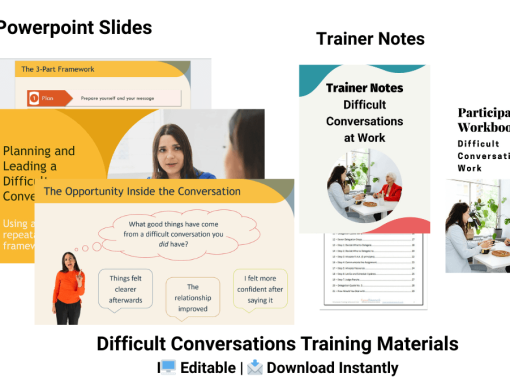
Need Ready-to-Use Communication Training Materials?
If you want to run a workplace communication workshop without creating everything from scratch, explore our editable trainer-led course materials.
View Communication Skills Materials