
In this business coach interview, Alistair Stevenson shares insights from more than 10 years as a corporate trainer, including how he entered the training industry, identifies training needs, engages participants, and approaches change management and problem-solving.
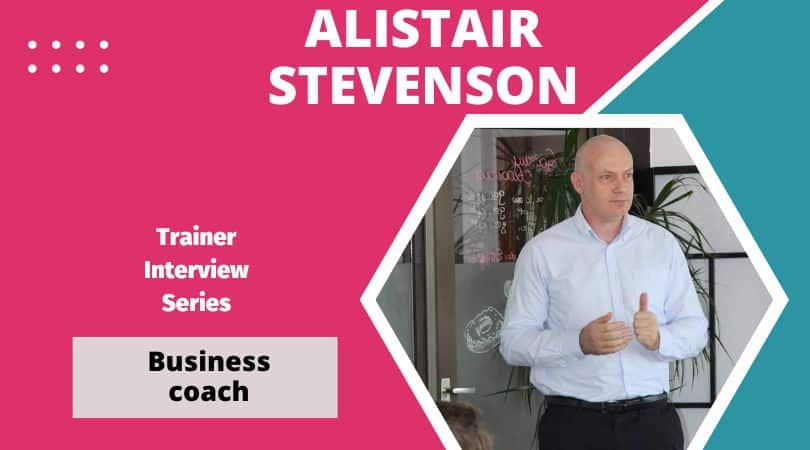
Business Coach Interview Questions: With Alistair
1. What’s Your Background, Alistair?
I have been a business trainer for just over ten years.
I was working as an MBA lecturer when I was given the opportunity to provide training in 5S (part of Lean Six Sigma) for a furniture factory in Poland.
I am originally a construction engineer, and I’ve worked in construction in the UK, USA, and Canada.
I moved to Poland in 1993 and did an MBA at the Warsaw School of Economics. I then worked in direct marketing, advertising, and medical publishing.
In 2004, I returned to the UK and set up a medical recruitment company.
In order to scale up, I moved the company back to Poland, where we had access to lots of highly skilled, well-educated people to help our business grow.
I later set up a company to provide injection molding tooling to the automotive industry. This is where I developed an interest in working to help processes work and run more efficiently for businesses.
I also work for a number of innovation agencies as a project evaluator.
In order to be awarded funding, inventors have to submit proposals that outline their innovations and what makes them special.
My role is to decide which proposals are suitable to be funded. It is incredibly interesting and enjoyable work.
I discovered a passion for facilitating business training courses. It has taken me throughout Europe and the Middle East, and I have met some remarkable people.
I have shared what I consider to be best practice and have learned a great deal from delegates.
2. What led you into the training industry?
I was working as an MBA lecturer in Poland, and my boss was contacted by a furniture company that needed a trainer to teach them about 5S.
5S is a Japanese methodology to enable manufacturers to organize production more efficiently. It is based on Henry Ford’s CANDO methodology.
I delivered the training for the furniture client, and the client was happy, and I discovered that I really enjoyed corporate training.
So the next step was to do more of it. I contacted several training companies and began working as an associate trainer throughout Europe.
3. What business coaching and training topics do you offer?
Strategic Planning – This involves understanding the main strategic planning tools and knowing when to use them. All strategic planning tools have their flaws.
Problem-solving – This involves identifying what the problem really is and identifying the root cause.
There are a number of proven tools that you can adapt to make sure you are treating the underlying cause and not just treating the symptoms.
Once you know the reason for the problem, the next step is to provide possible solutions, and then choose the best solution.
Change management – This involves learning how people come to terms with change at work and realizing that everyone is going to process the need to change in different ways.
What might be a minor inconvenience for you might be the Mount Everest of problems for one of your colleagues.
Having spent years leading change management programs, I have come to the conclusion that people do not really have a problem with change. They have a problem with being changed.
Leadership – It is surprisingly easy if you involve your team and make the decision-making process a team effort. Often you don’t have the luxury of being able to do so. Sometimes, in times of great crisis, you need to be able to step up and take control without damaging relationships.
4. What are the biggest challenges as a trainer?
Delivering a course that is going to benefit the delegate, so you need to understand exactly what your audience needs from the start.
There is nothing worse than spending four days with a group of delegates only to find out on the last day what they really need.
You are a business trainer, not a children’s entertainer, so you have to focus on providing delegates with useful tools and methodologies rather than just making sure that they have a good time.
It is essential that you understand what the delegates’ issues are and provide them with solutions to help them do their jobs more effectively. That is why it is so important to learn about the challenges that your delegates face so that you can better serve them.
5. What is your favorite part of being a trainer?
Meeting people. I have traveled throughout Europe and the Middle East and have met some fascinating people and learned about their issues.
What is really satisfying is when your delegates tell you about a problem that they have been faced with for years and cannot solve.
You ask a few questions to clarify your understanding and ask, ‘Have you thought about doing this?’ and you solve it. It is incredibly rewarding.
You get the feeling that you have made a difference and made someone’s life a lot easier.
6. How do you identify the training needs of the employees or people you train?
I get the group to work in pairs. They then interview each other and ask about the training needs.
I then ask a random delegate to tell me what the needs of their partner are.
This enables you to gauge how well they listen to each other or whether they were only focused on their own needs. I then ask their partner if they were right.
It is a good warm-up, and it enables some of the more shy, yet thoughtful delegates, to voice their opinions.
You also have to make sure that you cover all the topics listed in the course outline; otherwise, the training manager might feel disappointed.
However, by doing this exercise, you know where to focus your attention and deliver a course which is tailored to the needs of your delegates.
7. What is your top tip for being a good corporate trainer?
You are a trainer, not a lecturer. If you want to train a group about potatoes, don’t show a slide of a potato while telling them where potatoes come from and how they are served, as it is spirit-crushingly boring. Make it more interactive.
Try this. Show them a picture of a potato.
‘What’s this?’
‘No, it is not a rock, but good guess’
‘Yes, it is a potato’
‘OK, with a partner discuss the ways you like to eat potatoes. Don’t talk to me, talk to each other; you are much more interesting’.
‘OK, so how do you like your potatoes?’
‘Anna, you like fries. Me too. Do we all like fries? Fantastic, we do. OK, so this time talk to your partner about what you like to eat fries with. Is there a condiment that you like to have with fries?
Can you think of any national dishes from around the world that involve fries? I will give you two minutes.’
You have got to keep it delegate-focused. Otherwise, you will just stand at the front of the room droning on without involving the delegates.
If you open it for discussion, you will get the one person who always shares their opinion, and no one else will talk. Later when the feedback forms come back, they are unlikely to be flattering, and you might not get booked again.
8. What other advice would you give new corporate trainers?
Try and focus on the industry that you are working in. So if you are training the Navy in conflict resolution, resist the temptation to provide a case study from the automotive industry. The more a delegate can relate to an example, the more likely they are to remember it.
You can make the examples funny as they are easier to remember.
So in the case of conflict resolution, an example in an article might be a conflict between a husband and a wife, where one of the parties complains, ‘You made me feel upset when you did not remember to take out the trash.’
If you are working with the Navy, change that to ‘you made me feel upset when you did not remember to clear the torpedo tube.’ It gets a smile from the delegates, and it makes the training appear more focused on the topic.
Learn more about becoming a corporate trainer.
9. What do you do when you have a group of inexperienced delegates with one who is an expert?
There are two courses of action.
1. Ask the experienced delegate to explain and give concrete examples from work to support their opinion. Strangely enough, this does not always work so well, as the more experienced delegate quickly gets tired of giving their opinion and having to do what is essentially your job.
2. Provide exercises where everyone is an expert. So, for example, if you are training a group about the SWOT analysis, if you ask them to make a SWOT analysis of the company, you will get one or two experienced employees dominating the exercise. However, if you were to ask them to make a SWOT analysis of the region or the country, then everyone’s opinion is equally valid.
10. What do you like to do outside of work?
Outside of work, I lift weights and go for walks in the countryside.
I would like to continue to learn about interesting subjects and provide courses that delegates will find useful in their work.
My favorite place is where I live. It is near Dartmoor in Devon in the South West of England. An area famous for mountains and very small horses. When I say small, they are not much bigger than sheep.
Further Information on Alistair and How to Contact Him
- You can find Alistair on LinkedIn here.
- Find more freelance trainers career ideas and advice


