
A strategic thinking exercise helps participants practice evaluating options, considering long-term consequences, and making better business decisions. This free activity can be used in leadership, management, HR, and workplace training sessions and takes around 20 minutes.

This activity is one of many strategic thinking resources in our complete Critical Thinking Skills hub, where you’ll also find decision-making, problem-solving, and strategic thinking guides.
Strategic Thinking Exercise at a Glance
- Time: 20 minutes
- Group size: 4 people
- Best for: managers, supervisors, leadership training, and strategic planning workshops
- Skills developed: decision-making, analysis, strategic thinking, and discussion
How Do You Run This Strategic Thinking Exercise?
Time Allocation needed for the Activity: 20 minutes
Start by asking the participants to form groups of 4 people and give each group a copy of the ‘Strategic-Choices-scenarios’ handout.
The ‘Strategic Choices Scenarios’, in case you do not have the handout, is as follows:
Scenario No. 1: Market Expansion
Your company is considering entering a new market. Do you:
- Conduct thorough market research before making a decision.
- Launch a small pilot program to gauge the interest from existing customers.
- Go all-in and invest heavily from the start.
Scenario No. 2: Product Development
Your team is tasked with developing a new product. Do you:
- Focus on innovation and create something entirely new.
- Enhance an existing product to meet changing customer needs.
- Partner with another company to co-develop a product.
Scenario No. 3: Talent Acquisition
You’re hiring for a critical position in your team. Do you:
- Prioritize candidates with industry-specific experience.
- Seek candidates with a variety of different skills and backgrounds.
- Focus on promoting from within the organization.
Scenario No. 4: Technology Adoption
Your team needs to adopt new technology. Do you:
- Invest in the latest and most advanced technology available.
- Implement technology that meets your immediate needs.
- Wait for the technology to mature before adopting it.
Scenario No. 5: Competitive Response
A competitor is launching a similar product. Do you:
- Launch a counter-product with additional features.
- Focus on marketing your product’s unique qualities.
- Lower your prices to undercut the competition.
Running the Strategic Thinking Exercise
Assign one scenario per group and ask each group to quickly discuss the scenario and choose one course of action out of the 3 options given for each scenario.
Ask each group to prepare a short explanation as to why they chose a course of action, so they can share their ideas with the rest of the class at the end of the activity.
Allow 10 minutes for the small group discussion.
After the 10 minutes, create a class discussion by asking each group to share the ideas they have come up with with the rest of the class. Allow another 10 minutes for this.
If you are looking for more ready-to-use workshop exercises, take a look at these decision-making activities for employees to complement your strategic thinking training.
What Are the Best Answers to Each Scenario?
At the end of this strategic thinking exercise activity, you can explain the outcome of the activity and the case study responses as follows.
In terms of choosing the best course of action for each scenario, every option is potentially viable.
The best option to choose really depends on the specific circumstances for you and the company, so there is no absolute correct answer. If you are looking for a structured approach to evaluating different options, our guide to the 7-step decision-making process explains how to make well-informed workplace decisions.
Key considerations include:
- Your own goals
- Your organization’s vision
- The external environment in which you operate (e.g., the laws governing your field at the time, customers’ demands, the economy, fashion, technology, etc.)
- The internal environment of your company (such as your employees’ skills, the company’s culture, or its finances)
- The product or service you sell
- The potential impact of your actions and a lot more.
When you think of and implement a strategy, the factors above all need to be considered.
Taking into account these factors is an important part of strategic thinking and strategic decision-making.
Let’s look at each scenario and the options that are given as part of the strategic thinking exercise.
Scenario 1: Market Expansion
Option A (Conduct thorough market research before making a decision)
This is an analytical approach, which involves gathering comprehensive data and conducting research before making decisions.
It minimizes risk before entering the market. It can be a suitable option when you don’t know the market you are entering, and you have time to do your research.
Option B (Launch a small pilot program to test the waters)
This is an experimental approach, which involves testing the market with a smaller-scale initiative.
It may be a suitable option when you know something about the market you are entering, but you are still uncertain about how things might go and want to assess the risks.
Option C (Go all-in and invest heavily from the start)
This is an aggressive approach, which involves taking bold actions quickly. It may be suitable when you know something already about the market and if time is of the essence (if, for example, the competition is fierce, and you want to place yourself ahead of the others). It seems riskier than the two previous options, but it may be a calculated risk.
Scenario 2: Product Development
Option A (Focus on innovation and create something entirely new)
This option emphasizes innovation and differentiation, potentially leading to a unique product that captures the market’s attention. It can be highly effective if there’s a demand for groundbreaking solutions.
Option B (Enhance an existing product to meet changing customer needs)
This is an adaptive approach, where improvements are made to an existing product based on changing customer preferences. It may be suitable if you know that your customers like the product overall but have given feedback on things that need improving or updating.
Option C (Partner with another company to co-develop a product)
This option involves collaboration and joint product development, which can be effective if it leverages the strengths of both companies and combines their expertise.
Scenario 3: Talent Acquisition
Option A (Prioritize candidates with industry-specific experience)
This strategy focuses on hiring individuals with specific industry experience, which can be effective if the role requires deep industry knowledge.
Option B (Seek candidates with diverse backgrounds and skills)
Prioritizing diversity and varied skills can lead to a more innovative and adaptable workforce, which can be useful in a fast-changing business environment.
Option C (Focus on promoting from within the organization)
Promoting from within can boost employee morale and loyalty. Its effectiveness depends on the availability of qualified internal candidates.
Scenario 4: Technology Adoption
Option A (Invest in the latest and most advanced technology available)
Investing in cutting-edge technology can provide a competitive advantage, but it also comes with higher costs and risks.
Option B (Implement technology that meets your immediate needs)
This strategy prioritizes practicality and aligns technology with current needs, reducing the risk of overinvestment in unnecessary features.
Option C (Wait for the technology to mature before adopting it)
Waiting for technology to mature can reduce risks, but it may also result in missed opportunities for early adoption.
Scenario 5: Competitive Response
Option A (Launch a counter-product with additional features)
Enhancing your product with additional features can help you compete effectively by offering more value to customers. Careful thought would need to be given to ensuring that the new features align with customer needs.
Option B (Focus on marketing your product’s unique qualities)
This strategy emphasizes marketing and highlighting the unique qualities of your product. It can be effective in standing out in a competitive market.
Option C (Lower your prices to undercut the competition)
Price competition can be effective in the short term but may harm profitability and brand reputation.
Strategic Planning Training
In addition to this strategic thinking exercise, if you are interested in a fully prepared lesson plan with PowerPoint slides, you might be interested in the materials below.
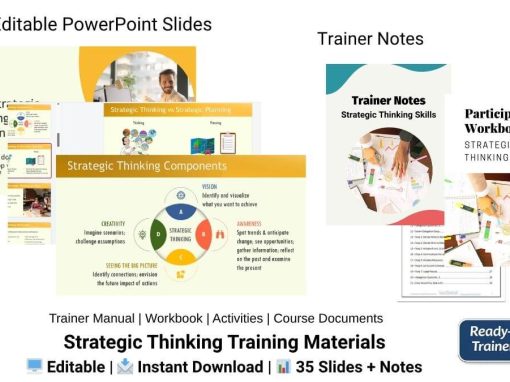
Strategic Thinking Materials
- Fully editable PowerPoint slides
- Trainer Notes & participants guide
- Printable participant workbooks, handouts & activities inthe PPTs
Strategic thinking often goes hand in hand with effective decision-making. Explore our Decision Making Training Materials for additional ready-to-use workshop resources.


