
Hybrid team management means ensuring that people working remotely and those who work from the office are treated equally and stay connected. Without structure, proximity bias and communication gaps can quickly undermine trust and productivity.

How to Manage Hybrid Teams in 5 Easy Steps
Managing hybrid teams well needs a plan and a sense of structure. You might want to consider following these 5 points:
- Create equal access to meetings, training, recognition, and career opportunities for all team members, no matter where they are located.
- Work to build trust and psychological safety by creating a team environment that encourages open dialogue and makes it safe and easy for employees to speak up, regardless of location.
- Make sure your team knows when to meet live and when to communicate through shared updates or messages.
- Agree on specific ways to measure performance and to track progress, and with measurable outcomes.
- Provide regular training for the manager on how to manage remote and hybrid teams.
These steps form the foundation of good hybrid leadership.
Managing Hybrid Teams: At a Glance
- ✔ Create strong team cohesion across locations
- ✔ Address time zones and communication gaps
- ✔ Build trust and psychological safety
- ✔ Ensure equity between remote and office staff
- ✔ Strengthen cybersecurity practices
If you are looking for more guides, make sure to take a look at the distributed workforce guides on the managing remote and hybrid teams in the workplace hub.
What Is a Hybrid Team? (Definition and Workplace Example)
A hybrid team in the workplace is a team composed of both remote employees and in-office staff (in a physical building together) working together toward shared goals.
Some employees might be working from Spain, Costa Rica, and NYC, for example, and other employees might be working from the company building in Bristol, England.
Work Models Compared: In-Office vs Remote vs Hybrid
What Are the Biggest Challenges of Managing Hybrid Teams?
The biggest challenges of managing hybrid teams include communication issues, proximity bias, team unity, and data security risks. Without clear structure and inclusive leadership, hybrid setups can quickly lead to workplace inequality between remote and in-office staff.
The main challenges are as follows:
1. Communication Issues
There are a couple of issues that can arise in hybrid teams in terms of communication.
- Intercultural Communication – Given that you might be managing remote employees from a variety of different countries and cultures, there can be miscommunication when it comes to culture. A thumbs-up hand signal, for example, is a good thing in most Western countries. In other countries, it can be considered a negative form of communication. Developing strong intercultural communication skills is essential when managing distributed teams, especially across different cultures and working styles.
- Time zones (I talk about this more later in this post in detail) can mean it’s hard to find a time to communicate, as has happened for a friend who runs a business and has to try and connect employees in Britain and Australia for meetings despite the massive time difference.
2. Equality and Equity
As an office-based manager working in person, it is inevitably easier to build rapport and unconsciously favor those you see in person more often, on a daily basis.
When managing remote teams, though, you need to learn to ensure that you offer the same opportunities to all employees, no matter where in the world or country they are based.
This phenomenon, often referred to as proximity bias, happens when managers unconsciously favor employees they naturally see more frequently in person, leading to unequal opportunities for remote employees who are less physically visible.
3. Team Cohesion
You will need, as a manager, also to work to build and keep a cohesive team. The solution to this is covered in the tips on managing hybrid teams in the next section.
4. Data security
You are relying more on the employees for data security and best practices when employees work from home or from a coworking location.
Data security does need to be considered carefully and managed well.
6 Key Benefits of Hybrid Teams for Businesses
The key benefits of hybrid teams include increased flexibility, improved employee satisfaction, access to global talent, greater diversity, cost savings, and reduced environmental impact. When managed well, hybrid work models can help you improve employee retention and engagement, and workplace performance.
When a hybrid team is well structured and managed, you can expect to see reduced overheads, better employee engagement, and greater employee retention rates.

1. Flexibility
Having the choice to sometimes work online from home or WFA (Work From Anywhere) means much greater flexibility for employees.
This can be especially helpful, such as for parents who need time flexibility in order to be able to manage childcare, or for an employee who is also a carer.
The time saved commuting also links into this flexibility, as it can allow employees to breathe more in terms of available time to manage their own non-work lives.
2. Employee Satisfaction & Happiness
With the aforementioned flexibility and opportunity to create a better work-life balance, the hybrid work option often leads to great employee satisfaction and happiness levels.
In turn, this leads to a reduction in staff turnover, something which is a high cost for many companies, i.e., the costs of rehiring and retraining employees.
3. Access to More Talent
When you include remote working as an option for employees you hire, you naturally have access to a worldwide pool of talent on which to draw.
4. Diversity and Inclusion
Not all potential employees have the mobility to find it easy to access a specific location.
Allowing remote working when managing a remote team means that you are potentially making it easier to hire talented individuals who might, for example, be wheelchair-bound and who would otherwise struggle to work for you.
Likewise, having a hybrid team also means the chance to hire worldwide, and this can be a more diverse team culturally, which can lead to a greater pool of ways of problem-solving and thinking.
5. Cost Saving
In addition to the costs for the employees in terms of commuting costs, letting employees work virtually has saved many companies a significant amount of money, as it can mean the need for smaller office space and reduced utility bills.
Some companies have greatly reduced their operating costs by developing hybrid teams.
6. Carbon Footprint
Anything that helps the environment must also be a good thing, and by including remote working, it also helps reduce the carbon footprint.
How Do You Manage Hybrid Teams Effectively?
Managing a hybrid team effectively requires great communication skills and the ability to create a cohesive team, no matter where an employee is based, whether online or in the main physical building. As a manager, you should try to address challenges such as proximity bias and ensure all team members feel included and valued, regardless of their work location.
1. Create a Team Mentality
One of the biggest and most obvious issues when managing a hybrid team of people working from different locations is the difficulty in creating team unity.
There can often be a ‘them and us’ type feeling generated when colleagues work together in an office in a physical location, versus those working remotely alone.
This naturally occurs because the group who work together from one office will find it easier to build rapport with each other, as a result of seeing each other each day.
As the leader, you will want to avoid this divide that can happen. You need to create a team mentality that everyone buys into, no matter where they are working from.
i) Weekly meetings
One of the first things I strongly recommend doing is to have a weekly or bi-weekly (or monthly if need be) video meeting, whereby everyone is included and is expected to be present.
If you want to structure these sessions more effectively, take a look at our guide on leading effective virtual team meetings.
These meetings should include giving one or two people each week a chance to talk about their work, including:
- a little about where they are working from, i.e., the location,n such as city/town, and about the local culture
- any challenges they experience working from a distance,e or their experience in the office
- and a little about themself, i.e., hobbies outside of work.
In other words, create a hybrid workplace where your employees still get to know each other and learn about each other.
ii) Monthly Team Building Event
I also recommend having a monthly team-building event that everyone must participate in.
Make the team-building event fun and use it primarily to build team rapport and for everyone to get to know each other.
Make sure, also by the way, to take a look at the free Virtual team-building activities that you can use.
iii) Annual Meet Up (if realistic)
It is increasingly common for companies with a fully remote workforce (or with a high percentage of remote employees), to organize a meet-up in a city or location somewhere in the world.
It will, of course, depend on the size of your company and the budget, but if it is realistic to do so, bringing your team together in one geographical space, once a year for a week, can be a wonderful idea.
Using the budgets saved in office space, heating, A/C bills, etc., it can often be practical to bring people together to really unify the team.
2. Managing Inter-Cultural Communication
Managing intercultural communication in hybrid teams means the need for strong cultural awareness, strong communication skills, and an understanding of inclusive leadership.
We might work, for example, with people based in different places around the world, whose first language is different, and who are from a great diversity of backgrounds and cultures.
This can make the workplace fascinating as we get to work with people from around the world, but it can also, at other times, result in misunderstandings and conflict (such as because of different cultural ways of doing things).
You should do everything you possibly can to embrace creating a well-managed workplace with respect for intercultural communication.
There are two things I recommend doing in order to go about building better intercultural communication when managing a hybrid team. These two things are:
- Provide 1 or 2 intercultural communication workshops for your managers and team leaders. This workshop can take place online and will help train them in simple techniques for managing an intercultural workforce.
- Do the monthly team building meetings (as discussed earlier) and include some intercultural communication activities, to help them consider intercultural communication.
3. Developing Trust When Managing Hybrid Teams
Trust is essential in any workplace, and it is equally so when managing a hybrid workforce.
Many of these trust-related issues are also discussed in our breakdown of common virtual team management challenges and how to address them. The difficulty, though, begins, for example, in learning how to:
- manage body language when you cannot see the whole person online (you cannot see all of their body language and the non-verbal communication, and thus, developing trust is different from seeing them in person)
- know how the employee is managing their time and workload
- develop a team in which psychological safety is embedded, in respect of how they feel a part of the team for all employees, regardless of whether they work remotely or not
- make sure that everyone you manage feels included, even when they work remotely (and often on the other side of the world)
Managing trust in hybrid teams can be challenging, but some things to consider include:
- have a policy of open communication, i.e., where your team feels comfortable to easily contact you and ask questions when they need to
- work to find the right balance between productivity levels and allowing your team a certain level of freedom and trust. Setting realistic weekly and monthly targets can be worth considering, with time flexibility built into the plan
- use the online meetings and online one-to-ones to develop trust, including by using effective listening skills on your part, and to improve empathy
As a hybrid manager, you should design for both synchronous and asynchronous communication. You could use collaboration tools such as Slack, Microsoft Teams, and Zoom to ensure clarity, transparency, and fairness across locations.
4. Managing Technology and Network Security
Hybrid team members need to be guided toward proper practice around good cybersecurity practices and safe digital practices, such as through training.
The level of technical ability of each team member will inevitably vary, and this has both security connotations and work balance implications.
As highlighted in recent Harvard Business Review research on cybersecurity resilience, building collective responsibility across teams is essential in distributed and hybrid environments.
A team member who decides (if you allow them to) to WFA (Work From Anywhere) must, for example, understand and be aware of VPNs (Virtual Private Networks) and the need to connect securely.
Likewise, the need for each employee to use anti-virus software and to ensure that they regularly run updates on their machine can be essential.
There are, in essence, many considerations, and thus, you, as the manager, need to provide clarity regarding the expected practice for staff working remotely.
You may also find it helpful to refer to official UK government cybersecurity guidance, such as the National Cyber Security Centre’s response and recovery advice for organizations.
In-house, this can be managed for staff working from the main office.
Solutions: Require clear guidance of the expectations you, as a manager, have regarding what they are allowed and not allowed to do.
Furthermore, when managing hybrid teams, you might want to provide a checklist to guide them on safe practices for security and clear guidance on how to get support for any tech issues they might have or experience.
5. Training and Development for Hybrid Teams
When you are in the same physical space as other people, it can be so easy to put more focus on those same people.
Suffice it to say that it is essential to ensure that you give as much time and thought to staff who work remotely, and ensure that they are also afforded the same training opportunities.
For HR professionals and trainers, our practical guide to managing staff working from home provides additional support and policy ideas.
Likewise, by the very nature of a hybrid team, some of the training that you will want to provide is related to the hybrid model. You might, for example, want to focus on topics such as intercultural communication, as mentioned earlier.
The training you might want to provide can include topics such as:
- Intercultural communication
- How to manage your own computer security
- Inclusive leadership (especially important when managing people remotely)
6. Time Management and Timezones

As mentioned in the previous point, if you, as a manager, are office-based, it can be easy to give the employees who share the same physical space more of your time.
It is very natural that even during a water, tea, or coffee break, you will inevitably end up chatting with colleagues and team members.
So the challenge becomes how to ensure that you give all employees, no matter where they are physically based, an equal share of your time (at least as best as possible).
With a hybrid team, time zones also become a consideration.
The temptation can be to organize meetings to suit colleagues who work in the same time zone or for the majority.
We also need to think, though, in terms of inclusive management and the need to ensure that all of the team are treated equally as best as possible.
For this reason, do consider holding team meetings to vary who it best suits if you have to manage employees across various time zones.
Where you have employees who are expected to work to the standard time zone of the company and who were aware of this from the start, then it is, of course, reasonable to expect them to adjust their schedule to match the meeting times.
This is the case for employees who you allow to work remotely, but provided they work the standard set hours. If they wish to work from Thailand but they do so knowing that they are expected to work to European hours, i.e., Paris time, then the employee needs to ensure they work to European hours.
In many hybrid organizations, asynchronous communication strategies are important in that they help to reduce pressure on real-time meetings and improve productivity across multiple time zones.
7. Effective Conflict Management in a Hybrid World
Conflict management is a skill that is required in every type of workplace, including in a hybrid world.
What makes conflict management especially interesting in a hybrid workplace is the differing types of conflict that can occur and that you need to deal with, as a manager.
The worldwide nature of hybrid working brings together people from various countries and cultures, for example, and this means that cultural conflicts can occur.
There might be one way of working in one country, i.e., where there is less priority given to time management and where more time flexibility is the norm (as long as people get their work done).
In another country, time might tend to be rigid in a certain company.
Likewise, in a hybrid workplace, conflict can occur from an otherwise simple misunderstanding, such as because of different terminology or the formal/informal way in which one speaks to colleagues.
I recommend providing conflict management training to your managers (and maybe even your team) so that they better understand how conflicts can occur, and some techniques to diffuse the conflict.

Hybrid Team Manager Checklist
Use this quick checklist to check your hybrid leadership approach:
- ☐ Do all employees have equal access to meetings, files, information, and training?
- ☐ Are you rotating meeting times across time zones?
- ☐ Do you actively consider proximity bias when making decisions?
- ☐ Have you provided clear, measurable goals for both remote and office staff?
- ☐ Have you provided a clear cybersecurity plan for expectations for remote staff?
- ☐ If you are HR or a company, do you have training on remote teams and hybrid leadership for managers?
If you cannot confidently tick each box, your hybrid strategy may need refinement.
Many HR teams and training facilitators use structured leadership training materials to ensure managers are properly trained to avoid proximity bias, to understand cross-cultural communication, and to build an inclusive hybrid culture and team. Having ready-to-use, editable course materials can significantly reduce your preparation time while providing training consistency.
Frequently Asked Questions About Managing Hybrid Teams
What is the biggest challenge when managing a hybrid team?
The biggest challenge is ensuring that proximity bias does not impact your decision-making as a manager. Even if you do not see an employee in person regularly, they should have equal opportunities for promotion, training, and career development.
How do you prevent proximity bias in hybrid teams?
To avoid proximity bias, give different employees the chance to manage meetings and take the lead, set clear goals and measure outcomes fairly, and ensure all staff have equal access to the tools and resources they need to do their job properly.
What tools are best for managing hybrid teams?
Regular collaboration tools, in particular, Slack, Microsoft Teams, and Zoom, are all useful for managing both synchronous and asynchronous communication across different time zones.
Why is psychological safety important in hybrid teams?
Psychological safety is important in every workplace, but in terms of hybrid teams, it is about ensuring that remote employees are not forgotten and have an equal opportunity to speak up and contribute, share ideas, and influence the team, regardless of where they work. This is essential for trust, engagement, and team performance.
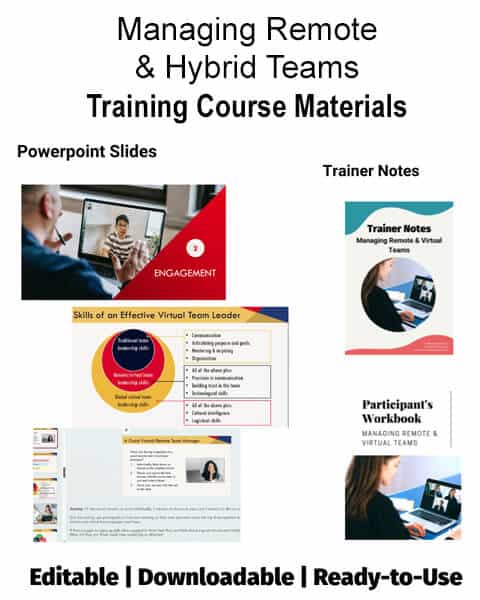
Managing Remote & Hybrid Teams Training Materials
If you are delivering leadership development or corporate training on remote and hybrid team management, our ready-to-use course materials provide structured content, practical activities, and editable slides to support your sessions.
- Fully editable PowerPoint slides
- Comprehensive trainer notes and participant guide
- Printable workbooks, handouts, and practical exercises


